

Welcome Avatar! Got a lot of new readers here. That said, we’re going write the same comment we’ve made since 2022. If you’re buying real estate please just focus on the Luxury Market. The only other alternative is extremely well researched flips/sweet heart deals. If you have one of those (sweetheart deals), you will know it and have no interest in the rate because the only thing you can’t change is the price.
We’re entirely aware that housing is a consumption asset. IE. saying to invest the rental difference is hilariously misinformed because control of the asset + zip code + being able to do as you wish = part of the value. There is practically no other asset in the world that you use every single day that goes up in value. Watches, cars, weird niche items still go down if you use them daily (wear and tear). If your stock portfolio is up 2% that day, it might impact your mood but it does get consumed in any way on a daily basis.
So. We’re going to go through all the important points in this post.
Starting with the good news: luxury is fine.
Part 1 : An 8% Mortgage Doesn’t Impact the Rich
If you’re already rich, the stated mortgage rate does not impact you. As many of you know, we’re already on buy, borrow, die which illustrates the point (source). If you have assets, you can open up a much wider range of funding options. You can borrow some money from a heavily over-collateralized stock portfolio.
Simple Example You Can Look Up Right Now on IB (Source)

General Real Estate Trends Also Showing the Same (Source)
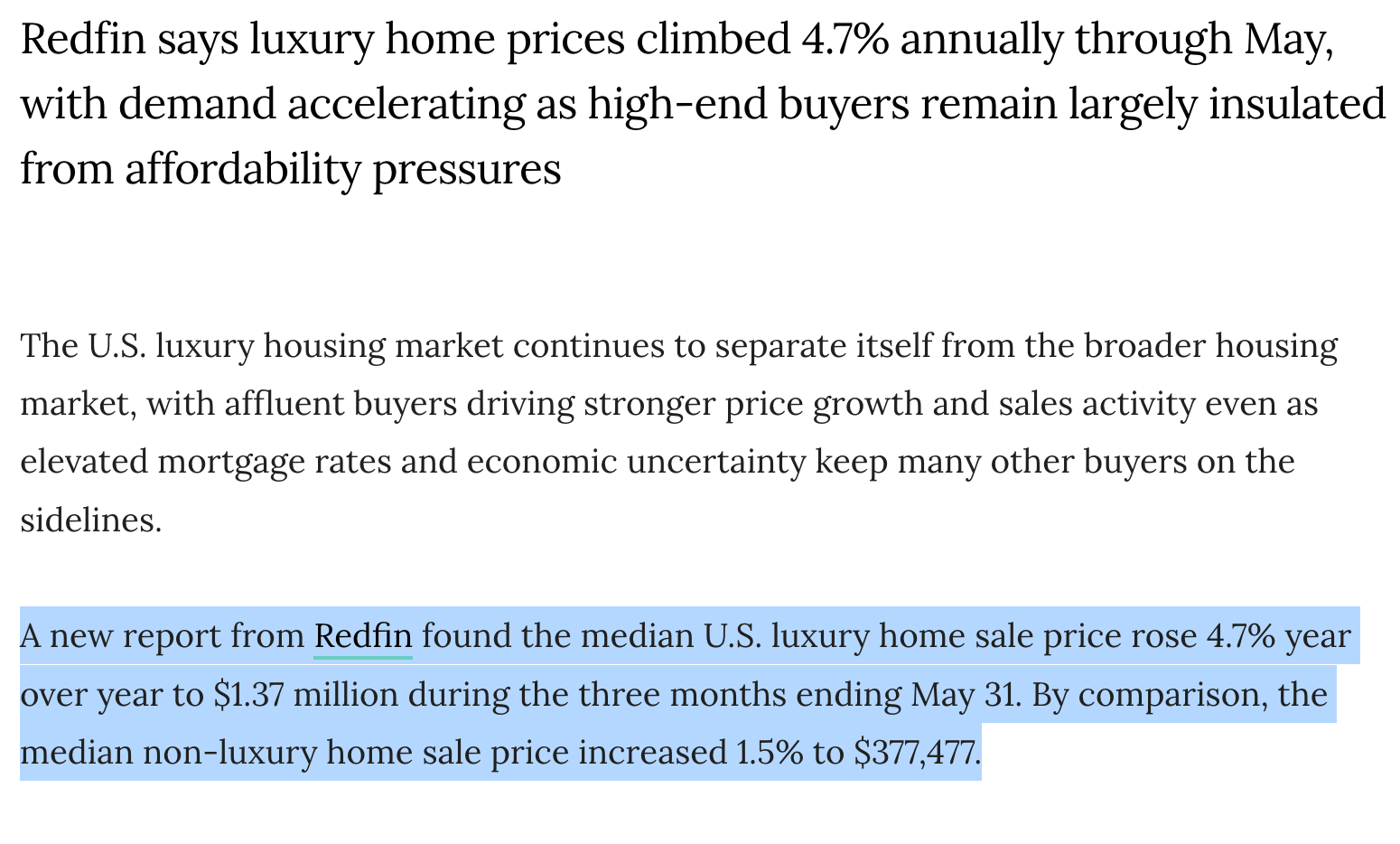
Simple Explainer: In the real luxury areas (rough cutoff for luxury is 3x median single family house value in any city), the funding options are not the same. Wealthy people can: 1) buy cash, 2) already have 3% rates from 2021 that they won’t touch and 3) can also use various other options to get the rate down - or a hybrid of higher down payment and shorter duration loan.
These are all the financial tools available to the wealthy. Beyond that there is also the consumption value you get by being in the nice neighborhood. You get access to a much higher quality peer group, safety, better schools and memories/utility out of the asset as well. There is no way to put that into a spread sheet. Just know that it is certainly not worth “zero”.
If you attempted to rent in the same place, you can’t really decorate the house or make any changes. You’re still at the whim of the owner who could sell it, move someone else in and boom you’re out of the school district and need to move again.
From what we’ve seen most people who argue that you should “always” invest the difference in the stock market do not have families. If you don’t have kids and you are single, we’d actually agree with the renting crowd. There is limited value in public goods if you’re single (which is why most young people live in major cities which are notoriously designed for hustle and bustle)
The Rich Can Borrow Later: Most just think about down payments and the maximum monthly outlay they can afford. The rich think in a completely different way. Unless something extreme happens, they do not sell. They sit on the asset for years and years until they can get the price they want. Or. The valuation goes up enough and rates are low. This leads to cheap “land banking”
Crash Bros = Doesn’t apply to Luxury as Much: While you can always find exceptions to the rule, even during the massive financial crisis in 2008, luxury held up better. The typical median house went down about 30%, the luxury market only went down about 15% (some markets were only down 10%). To keep it simple just say 1/2 of the downside vs. the median.
Simple Summary
While we always get blasted for short posts that get taken out of context. We’ll continue to do it.
If you want a simple decision tree for wealthy/luxury/higher end decisions it is pretty simple. If you’re going to buy you should be certain that you are there for 10+years. In addition, you should be starting a family or already have one. You do not want to get kicked out of the right school district/region/neighborhood.
If you’re single the decision tree suggests you rent. You could invest in stocks and other assets that will keep pace with home price growth. (Hint: if any member of the opposite sex is upset that you live in a 1BR apartment as a single person, you are better off ditching them anyway!)
We’re sure there are exceptions to the rule but that’s the simple heuristic.
Real estate isn’t some stock you can trade every year. Transaction fees, carrying costs etc. You want to stay for a long time. Let inflation eat away at the debt and enjoy the asset you will sleep in for 10+ years.
Part 2 : Explaining Why the Middle Is Ugly
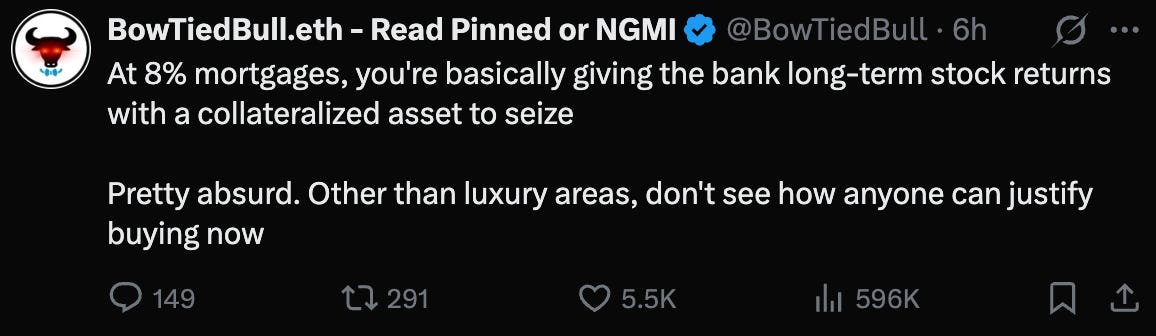
This post is blowing up like the Middle East. Not sure why but that’s how the internet works. Since 2022 we’ve said much of the same “K-shape” economy where rich get richer and middle gets pressed/squeezed into lower socioeconomic status. This is also why we said that middle of road real estate was a bad buy.
So far, accurate.
Stocks vs. Real Estate: We’re not even going to do the blah blah math. On paper and in excel, if you were to invest in stocks and rent you did better. Everyone knows that if you just put it into excel. The main issue is that life isn’t a spreadsheet and if you plan on having kids/starting a family, the decision tree doesn’t have you raising 4 kids in a studio apartment to save money. Homes shouldn’t go up as much as stocks because there is utility/consumption in the asset (returns are also levered for a reason).
Now that we’ve beaten that to death, here is the wild part.
The bank underwriting the debt gets access to: 1) stock market returns off your debt and 2) ability to simply take your house if you can’t pay. This is attempted asset stripping (source).
Asset Stripping of the Middle Class: Right now we’re reaching a point where bills are consuming the entire paycheck. This is happening in upper middle type income ranges as well. Since wages didn’t go up significantly, savings get depleted.
Slow bleed out in Savings Rate - Suggests a lot of people are in the Red
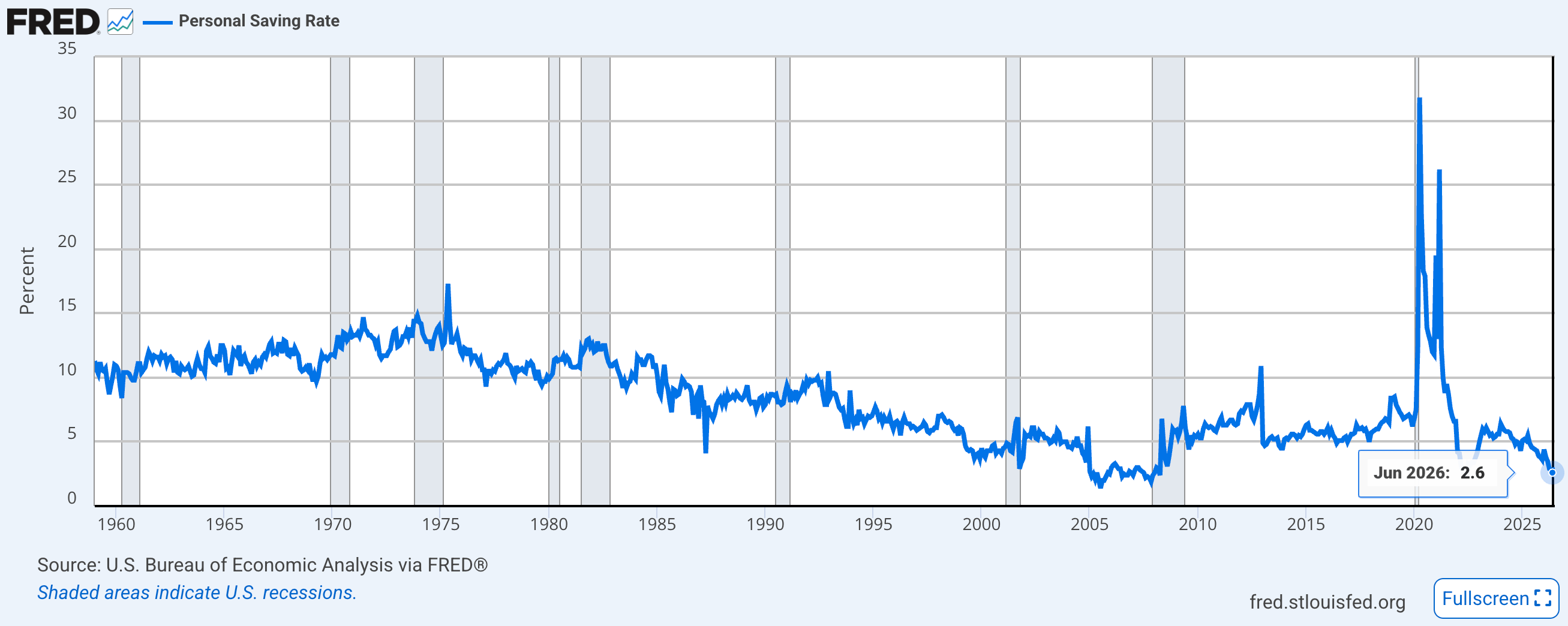
Once that happens, the middle is forced to liquidate assets and reduce their quality of life. This could result in selling the house and moving into a condo. It could result in selling cars, jewelry, collectables etc. Point is the same. Assets get sold to make up for the gap.
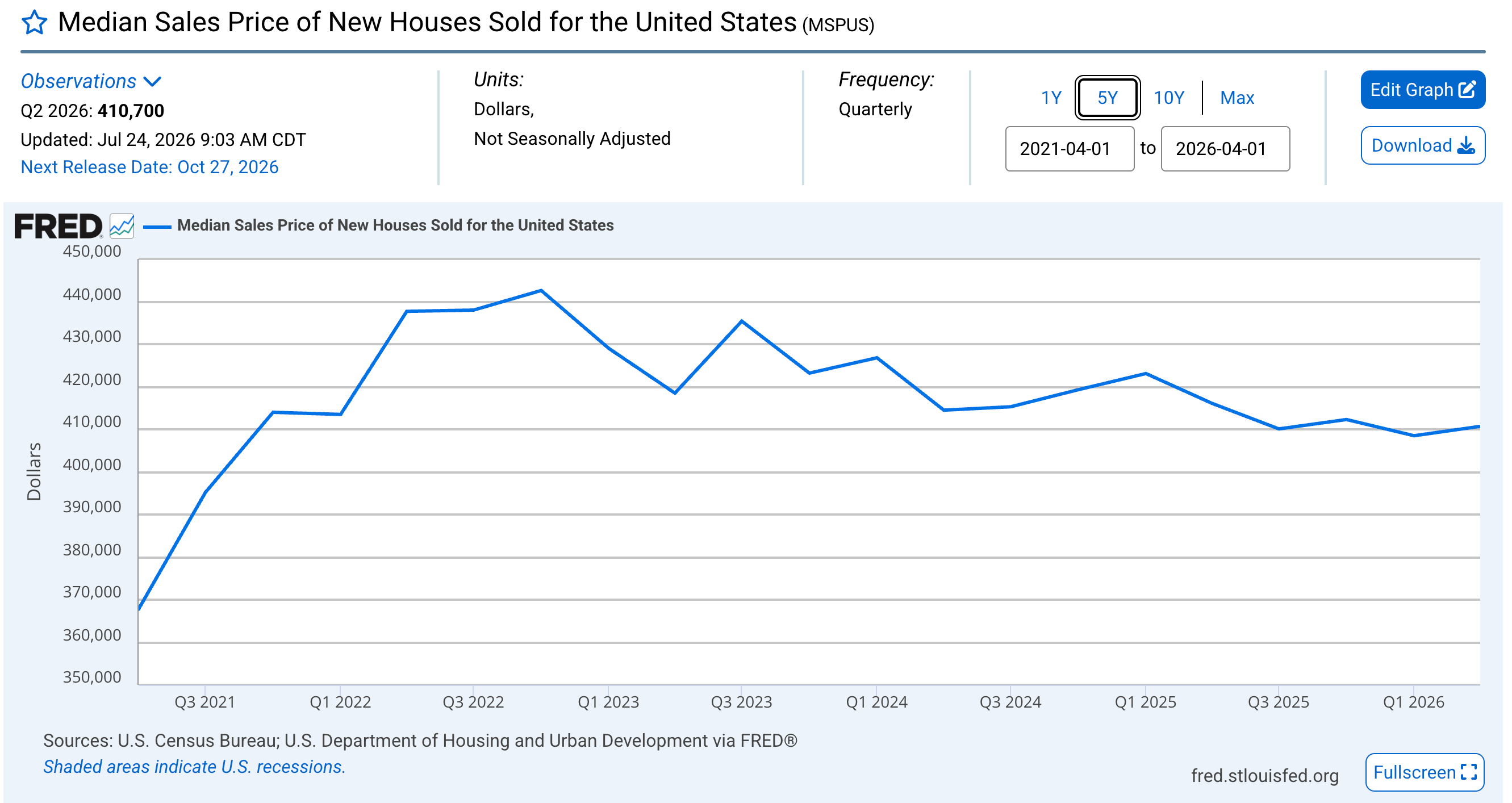
Under The Hood: The middle is a completely different beast. In this general zone, there are two groups: 1) low mortgage rate from the 2020/2021 era or earlier and 2) people who do not have that luxury. The second group is entering into forced selling mode as soon as there is a tiny economic blip. We can see this as the prices remain flat (stagnant market) and unemployment hasn’t cracked. Unlike the wealthy, a job loss leads to forced selling.
A Great Parallel
If you want a pretty good comparison how about 1995 to 2000. This is probably a great example.
1995 Inflation was 2.8%, 2000 inflation was 3.3% - sounds familiar!
1995 to 2000 was a major tech wave - sounds familiar!
1995 to 2000 mortgage rate was around 8% - sounds familiar again!
Debt/GDP in the same era was only 55-65% vs. 100%+ today (important as yields can go even higher if bond market thinks risk is elevated)
Now here is the other major difference:
2026 Price/Annual income of a house is about 4.7x. In 1995 and 2000 it was around 4.0-4.1x
This means the typical buyer today has to shell out even more money (relative to income) when compared to the 1995-2000 tech boom when we had similar inflation and mortgage rates. This is why we keep saying “middle will struggle”
If you think that we’re in the middle of another mega tech run (1995) then prices should be lower and if you think we’re at the peak of a bubble (2000) then prices should be lower. The only tricky part is all the frozen inventory from the ZIRP policy from 2010-2021 or so.
Part 3 : Put It Together
Housing is always an emotional topic. The majority of homeowners are not liquid millionaires and their wealth is largely tied into the house.
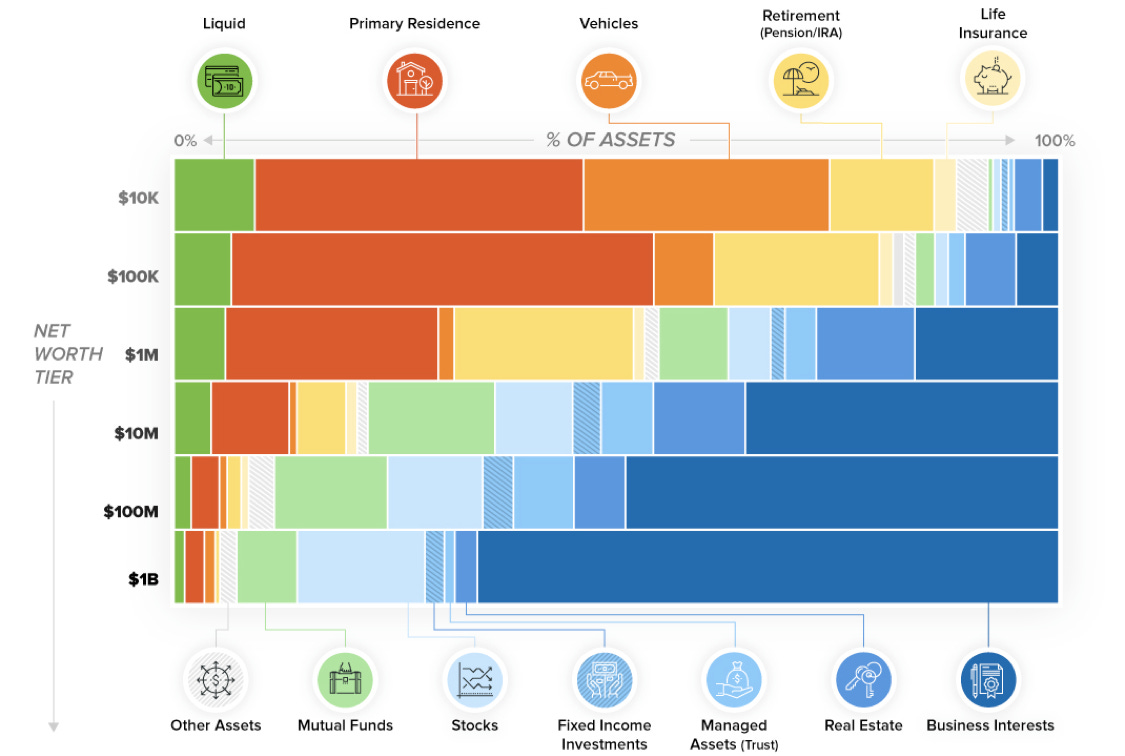
This is why it always gets a visceral reaction. That said recognize what high interest rates represent. It now represents stock market type returns (for the bank) with the ability to seize if payment is not met (asset stripping is the new goal)
General Rule
If you’re single, you really shouldn’t care much about buying a house. You’re not going to fill it with kids so there is no real point. You can mimic the return with a wide range of financial products (REITs, general stocks etc.). While it won’t be perfect it’ll be good enough.
If you’re deciding to buy and stay somewhere for 10+ years, here is the general idea with ~8% mortgage rates:
Under no circumstances do you assume rates will go down. You only buy if you are comfortable with the interest rate written on the contract. If you can refinance later that is a bonus it is not part of your buying strategy. Similar to purchasing a company, you never buy based on what will “improve later”. Price is based on status quo
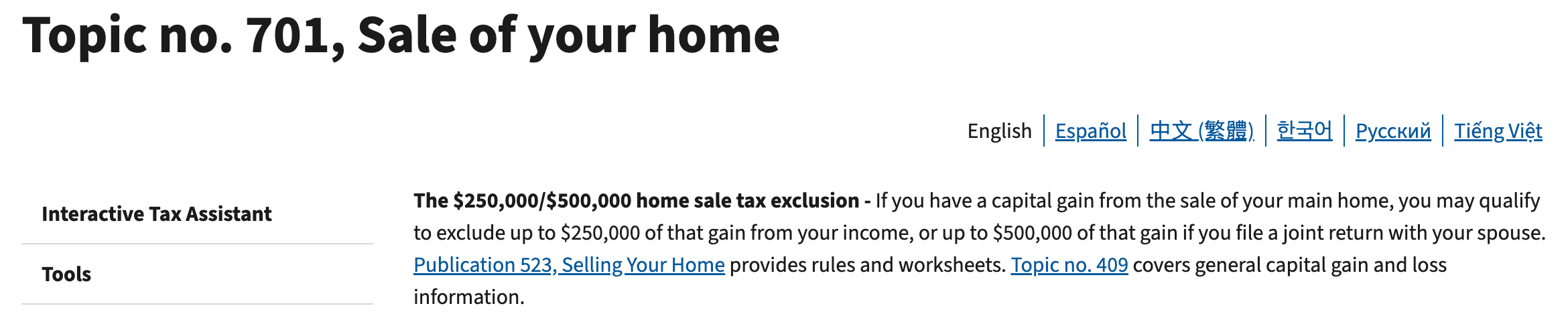
Don’t buy assuming you’ll leave in about 5-years. You should really focus on that 10+ year horizon. The transaction costs + loan origination fees will kill your returns. Long-term holdings open up huge tax benefits $250K and $500K for married couples = 0% cap gain for primary residence sale
The house needs to be big picture lifestyle design. Since we’re suggesting single people rent, we assume that you have a family if you want to buy. In that case, the lifestyle value needs to be estimated: 1) school, 2) value of peer, 3) safety, 4) general quality of life and 5) work/income optionality if applicable. Renting is 100x harder with kids who are going to school because switching to a different neighborhood may require new friends/teachers/options. If you become a parent, best of luck telling a 7 year old that he’ll be leaving his best friend next year!
Once the transaction is done, delete zillow/redfin/propwire and all those websites immediately. Since you’ll be locked in for 10-years it is unhealthy to watch your net worth fluctuate like a stock
Bonus: While the focus is always on the luxury areas (best school districts/community/network), if you can get some forced appreciation that is extremely valuable. Worst house in the best neighborhood is a great strategy for a reason. You can’t change the price and you can’t change the zipcode
On that note big welcome to the new people who found this side of the web. Despite this post being about real estate we actually don’t care much about it vs. tech/crypto/e-com businesses.
People wonder how these homes are being purchased and you’ve stumbled onto the right place. They are being purchased by the digital realm. The way people make it up the socioeconomic ladder is by utilizing new technology (E-com, AI, software, etc.).
Our prediction is that the “new money” will continue to tilt towards small business owners. While SpaceX and early OpenAI/Anthropic employees will always get the headlines, the majority will get their step function from a small business. It is awful and requires 3-years of suffering, but the other option is being forced into the bottom of the K.
The rest is up to you.
Disclaimer: None of this is to be deemed legal or financial advice of any kind. These are *opinions* written by an anonymous group of Ex-Wall Street Tech Bankers and software engineers who moved into affiliate marketing and e-commerce.
Old Books: Are available by clicking here for paid subs. Don’t support scammers selling our old stuff
How ETH is Staked: Covered (here)
Crypto: The DeFi Team built a full course on crypto that will get you up to speed (Click Here)
Crypto Taxes: We have a suggested Tax Partner and 25% discount code, for information see this post.
Security: Our official views on how to store Crypto correctly (Click Here)
Social Media: Check out our Instagram in case we get banned for lifestyle type stuff. Twitter will be for money