

Welcome Avatar! We’re going to make the argument that the first $4M is the hardest. About 25-30 years ago it was “the first million is the hardest”. The problem is that $1M now and $1M back then buy completely different assets. Make no mistake, a million bucks takes effort, the path to $4M is simply a different level for the majority.
Part 1: How People Get Trapped
Too Many Options: If you are willing to take some risk or work long hours you’re going to get to $1M by default nowadays. This side of the internet is not working minimum wage. Majority work in some high paid position (Wall St, Sales, Tech etc). Their goal is to actually make it. Making it requires a paid off home and around $4M liquid (squabbling over exactly $3-5M being the liquid part misses the point)
The reason why our audience has moved to this framework? It really isn’t hard to get to $1M as a high performer or hard worker.
Entry Level Tech, Wall Street and Sales all roughly
Make about the same. No need to argue over $10,000-$20,000 that will be a rounding error for you in a decade. The majority will make about $15K pre-tax a month or about $180,000. Some years better, some years worse but that’s about right.
If you start here and do anything on the side, we’ve never seen someone fail to come up with an extra $40-60K (you could even flip stuff on e-bay to collect $40K). That’s already landing you at ~$220,000-$230,000 a year. A smart investor/saver etc is going to put away 30% or so.
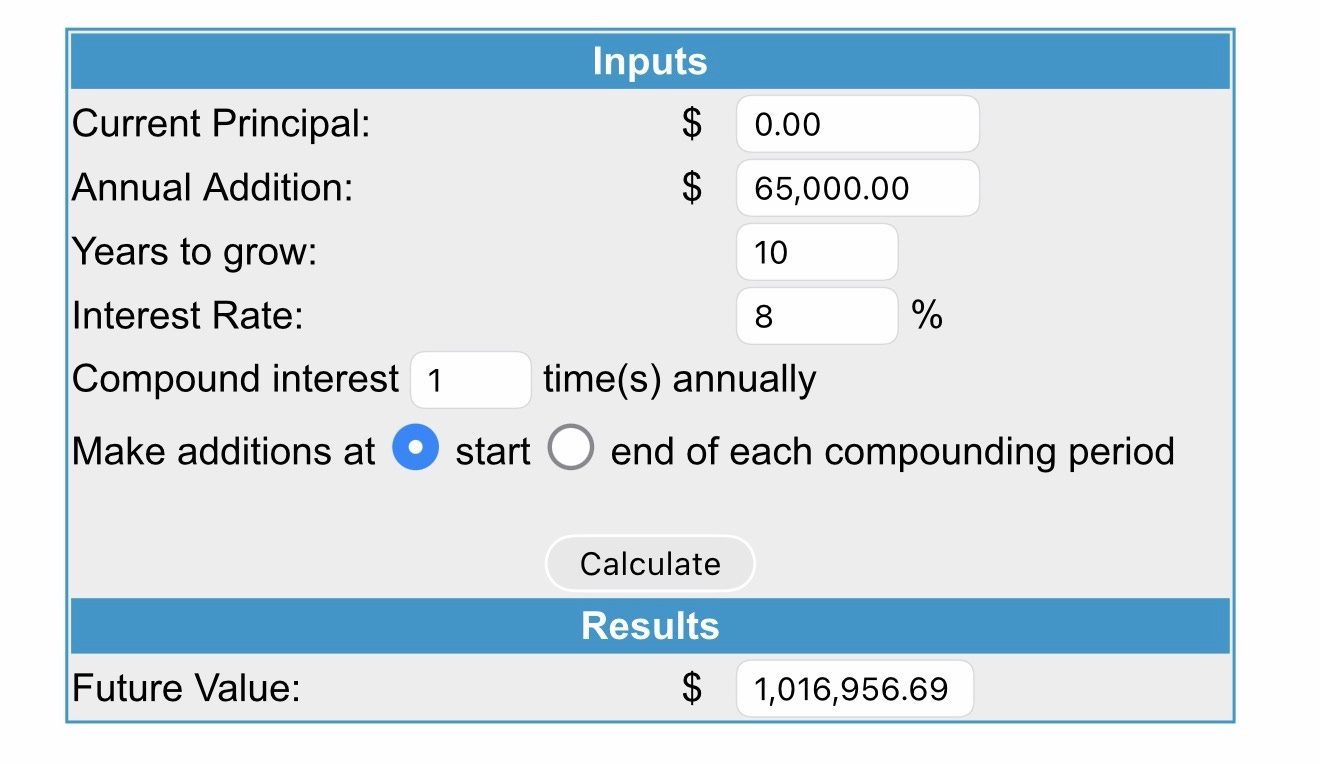
$65K a year for a decade is already over $1M. This assumes no wage growth, no business growth, no nothing. You’re 31 and already a millionaire, woo!
Reality sets in: Around this time frame most wake up a little bit behind the 8-ball. They wake up and say “wait a minute none of my bosses seems happy or rich”. If you put the $1M to work, realistically about $400K will be eaten into a down payment and $600K is left to invest (this is how high cost of living areas work, blah blah live in Idaho blah blah, reality is that the high paid positions are all in expensive areas where $2M for a house is pretty normal). This does not look like generational wealth or F-you money any time soon. In fact you don’t change your life at all and simply pay a bit more into mortgage which offsets all the salary increase over the past 10 years.
In simple terms, your annual spending on housing as a percent of income doesn’t change
Can’t make that more clear. While you are richer on paper, the cash outlay on housing is still no different so you don’t “feel rich”.
Most people try to double or triple down on a career. The problem is that the company knows you’re stuck so the annual wage/salary/bonus/total compensation ***percentage*** increase is much much lower.
You start running the math. Since you have a mortgage + likely starting a family, you’re not going to save more than 10-20%. Which means you’ve got until 60. This assumes you don’t have any catastrophic events: 1) health issue, 2) industry job loss, 3) sudden change in management and 4) a wide range of low probability events from a industry depression to new tech making your sector obsolete. Since you are trying to survive for 30 years all those “2-3% chance items become extremely probable to happen once. It’s basically a coin flip since 98% not happening for 30 straight years is 54.5%.
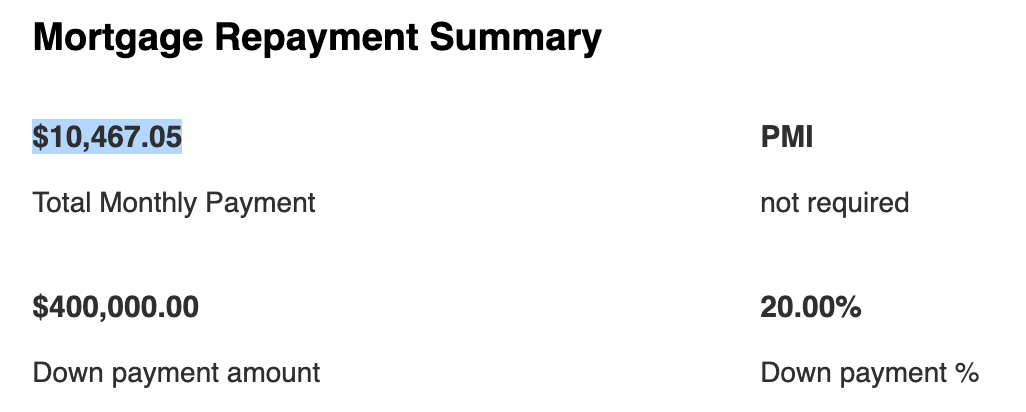
While Your Income Went up, Your Monthly burn on housing went to $10,467. Just for the Mortgage on a $2M home in a HCOL Area where all the high paying careers are.
Part 2: What Happens Next
Now we enter into two phases: 1) the complacency phase or 2) the realization phase - somewhat covered above.
Complacency Phase
If this is you, you’re in for an extremely rough life. Everyone around you says “you’re a millionaire so you’re fine”. Reality is that those high paying careers can go to zero. Not -90% not -50% but a flat out zero.
If you don’t think this is true, go look up old managing directors on Wall Street. You’ll see a litany of them going into “consulting” for 1-2 years. Then suddenly they are in a random corporate gig that pays $250K. This is a -66%+ down-draw and doesn’t include the 2-years of coping while being unemployed.
This is extremely serious. If you get complacent you’re risking everything. Your career. Your livelihood. And. Your family if you have one (majority of well off people will end up having kids)
What Typically Happens: Usually it is about 7-8 years of a good run. You’re clearing $500K to $800K. The problem is that those years also require the largest and most outrageous spending increases: 1) mortgage, 2) child care, 3) child development items - school, sports, music lessons and 4) general quality of life increases such as better food, nicer gym etc.
As long as income is up, this seems fine. Until you look around and see a graveyard of people who get cut and do the standard -66%.
The majortiy of people who get BBQ chicken cooked think “Okay i just throw $1M into the S&P and i’m fine”. This is only true if your income is stable. If you have no earnings for even two years… where is the money going to come from? The complacent people didn’t adjust for the risk of income loss.
You spent about 10-15 years climbing
Try to harvest the $500-800K a year income during the bigger earnings year
The average tenure nowadays is probably around 7 years and that is while your expenses have ballooned
If you get cut, you’re going -50-75% into a $340K Corp Dev Role. At this point you’re treading water
When Cut you don’t jump to the high-end. You end up somewhere around VP wiith around $338K in income (just using the median)

Autist Note: We’re well aware the exact calculation of the decline isn’t perfect. This is nitpicky and misses the point. If you had a huge year making $1M, maybe the decline is 70%. If you were making $500K maybe the decline is only 40%. The big picture is this. If you lose ~50% net income how exactly are you going to save to get ahead?
Realization Phase
The smart people realize that this was an inevitable situation. Instead of trying to impress every single person up the chain, they just do the minimum to be a top well liked person. If 5 people are up for promotion they land at #3-4. Make sure that the promotion is guaranteed, nothing more.
This requires significant ego management. You have to be cheering on the guy who got ranked #1. He will constantly give you passive aggressive remarks that he is better than you. Simply accept it and actually encourage it. “Yeah you’re just gifted at this i can’t roll like that”.
He doesn’t need to know that you’re building an escape via WiFi money on the side because the math doesn’t work. Every $20K extra bonus he gets is a whopping $10-12K after taxes. If you earn a meaningless $50K per year from a wifi biz, at a 4x multiple that is $200,000 on top of the $50K you’re throwing into the bank.
Most Start too Late: You’ve watched as numerous jungle members have scaled to 7-figure businesses. If you notice a trend? They don’t announce they are quitting until they are well beyond 2x W-2 net income from WiFi Biz. In fact, the common comment is always the same “woah it got that big!”. That is literally how it works. Anyone smart is still shipping in the minimum to get that decent bonus check, they just keep the WiFi hustle on the side to themselves.
Hint: If you know a person who is seen as strange but gets promoted “just barely” and isn’t giving it his all… that guy is the person who ends up quitting and B-lines it to 8-figures or more. Copy his strategy.
Part 3: Add It All Up - Why It is So Hard to Get to $4M TODAY
No matter which position you’re in (working and complacent) or WiFi biz secretly grinding, you know that math is not on your side.
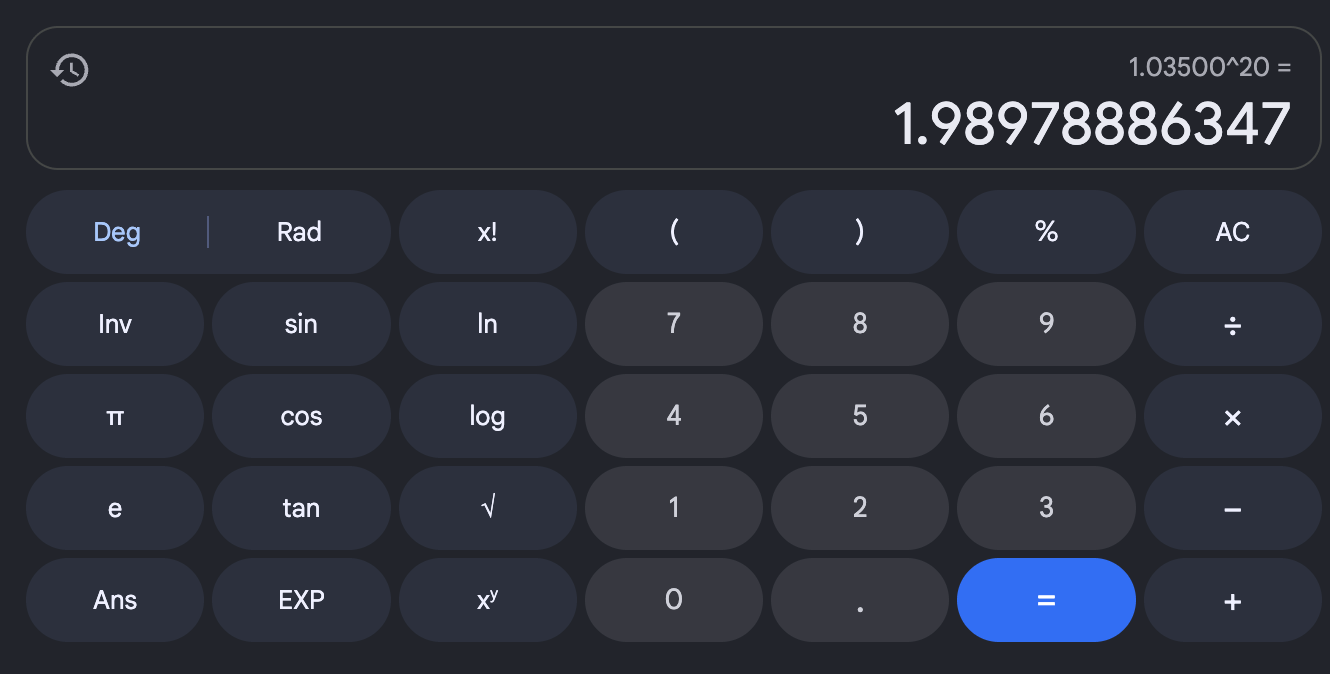
If you put $1M into safe stuff and get 7% for 20 years. You end up with $4M. The problem is that 20 years from now it is only worth $2M!
3.5% inflation for 20 years means your money/purchasing power is cut in half.
Both Realize This: The wild part is that both parties in the complacency and realization phase mathematically understand this. Even if they came up with $100K extra per year, it is not going to to be easy to get to $4M. This sounds insane but if you look deeply into the numbers it makes sense. Mortgage is huge, kids likely costing $50-100K pre-tax etc. You no longer want to drive a 10 year old toyota. Eating ramen noodles isn’t exactly a thing anymore.
The complacent party says: “Ahh well i won’t get rich but i’ll be fine in retirement and living well”. Which is dangerous because there is <25% shot they keep the income for 30 years.
The realization party says “Ahh well i MIGHT not get rich but at least i have a shot and if i lose my job i’m still fine”. The belief system is massively different. Massively. One group is assuming the status quo. The second group is assuming the worst but buying hope for the future. If you know anything about lady luck, she rewards the people who take calculated risk. We all know how this ends.
Realization party has two outcomes: 1) some good luck/grit/effort they hit 8-figures plus and are beyond their wildest dreams, 2) they have everything go wrong and they are still living the same quality of life they had when in the grind W-2
Complacent party has two outcomes: 1) they do survive and keep their current style, 2) they get BTFO and suddenly their quality of life falls off a massive cliff.
Investing Also Gets Complicated
Beyond this, the complacent group is operating from a scarcity/fear belief system. The realization group is operating from a working capital perspective because they actually have another option.
If you need the money to compound forever, you can’t really buy anything beyond the S&P and safer investments
If you have a business you need the money to buy inventory and buy ads. These have a stated ROI of at least 20-30%. Therefore, your only investing is really the money you don’t need to grow
If you’ve never tried to build anything on your own the prior paragraph sounds absurd. If you’ve built a business a light bulb is going off in your head and a five alarm fire drill “oh so that’s why i started looking at asymmetric risk assets…”
Psychologically The Trap is Basically Set: Group 1 is relegated to low risk stuff. They can’t afford an error. Group 2 knows that no matter what they will be able to cover the bills.
This means group 2 is attracting luck by default. They can consider new projects and the risk is mitigated by the multiple income streams.
$1M net assets, go to zero on income? You’re burning it within 5-7 years
$1M net assets, go to zero on two incomes? You’re burning zero of it within 5-7 years
Part 4: Where it Gets Ultra Complicated
The above is for around 95% of you. The majority of you are making less than you are worth because that is why you were hired in the first place. Would you hire someone who loses you money? Yeah of course not.
There is a small 5% sub-set though “the super employees”. These people earn outrageous sums of money. We’ll draw a rough line at $1.5M. If this is you, this is no different than having two income streams. If you have a choice between $500K W-2 and $300K WiFi money or…. $1.5M straight and no WiFi… You should take the $1.5M. You can make it work. You sleep in a cheap place, live WAY under your means and you can put away $2M in two years. Now you’ve got $3M and you’ll be at $4M in ~4 years.
This is the exception to the rule. If you are the exception to the rule you already know it. The exception to the rule doesn’t need to ask. A professional athlete earning $5M a year with a $5M/year guarantee for 5-years… is not asking about WiFi money. The guy making $250K-600K is 100% asking about WiFi money.
In short, if you’re asking if you should start a business the answer is YES AND YESTERDAY YOU’VE ALREADY LOST A DAY.
$4M Is the New $1M
Back in 1990 $1M was fine. At 5% you were getting $50,000. That was worth 45% of a house. Today? $4M at 5% is $200K. This is hilariously about 48% of a house. Close enough.
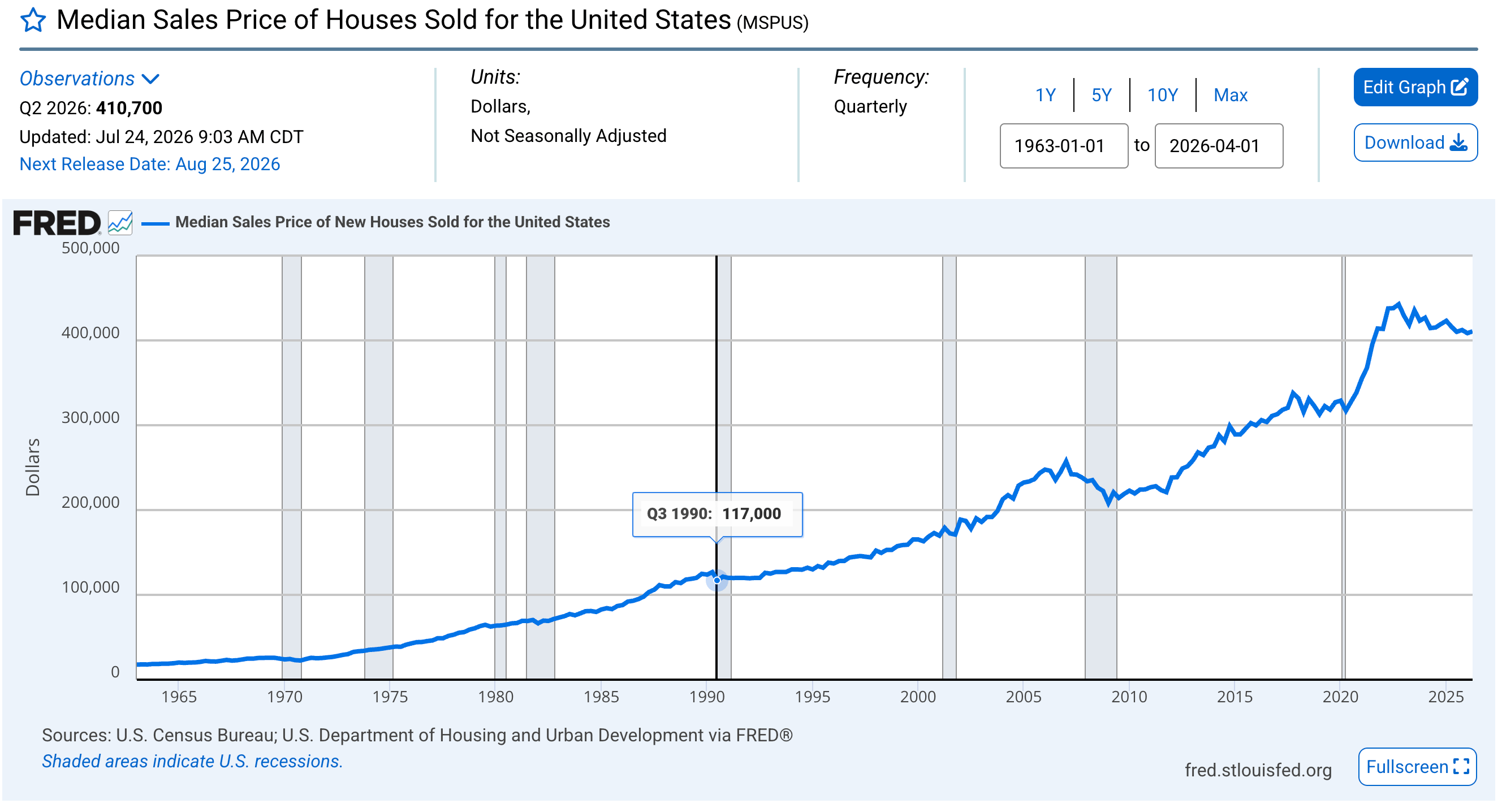
What Will it Buy: Before we get flamed on X/Twitter, ask yourself what $200K buys? You’ll realize it buys exactly the same amount of stuff from 1990. We’re actually being generous because $50K used to buy 66.75 shares of S&P 500 now $200K only buys 26 units.
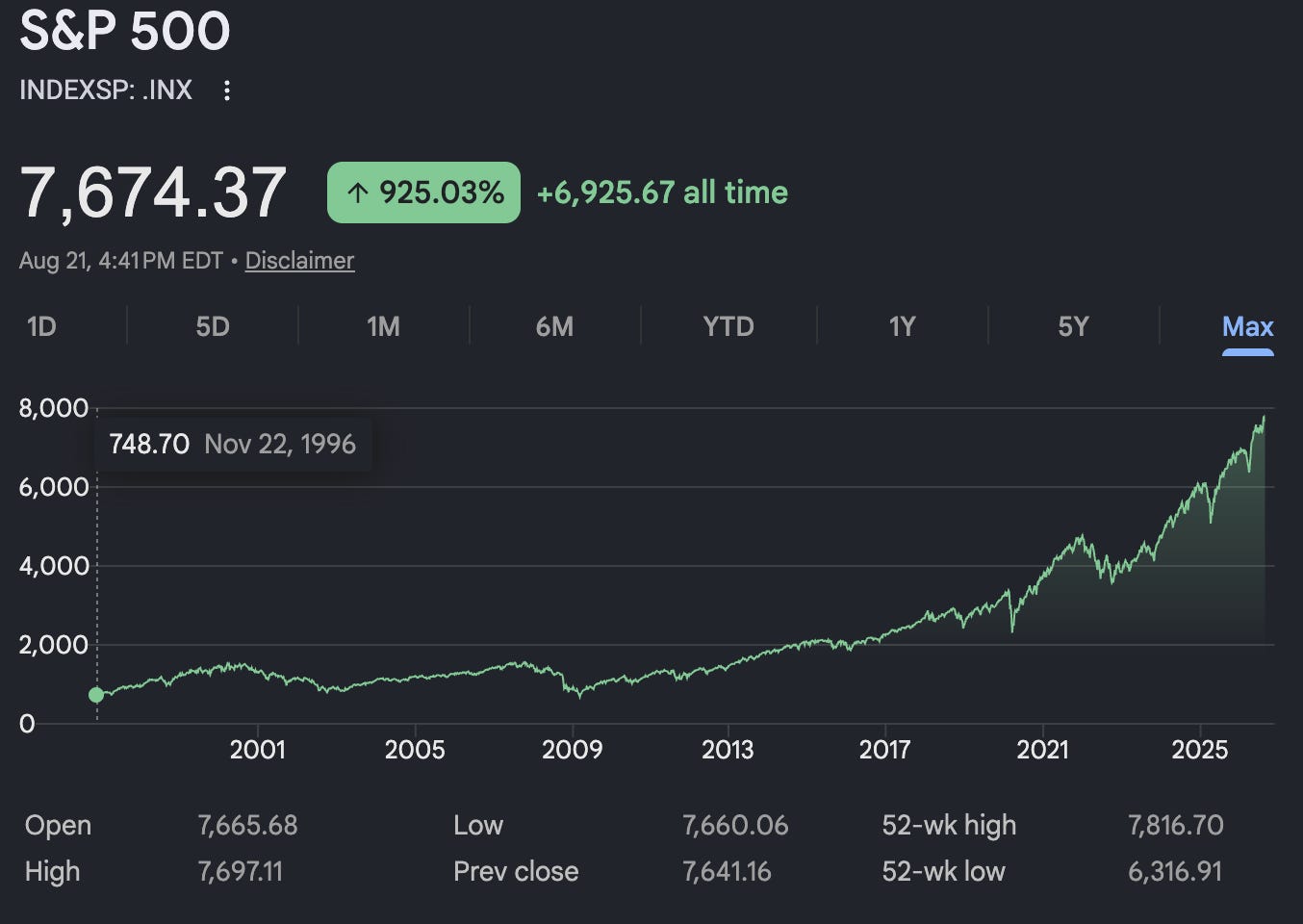
$4M is the new $1M. Figure out how to get there, do it as fast as you can.
Good luck anon!
We’ll be building wifi businesses, investing in tech and shipping into cryptographically digital assets over the long-term. We’ll see everyone on the other side!
Apologize for more typos/grammar errors than usual, got stuck at an airport but wanted to explain this ASAP!
Disclaimer: None of this is to be deemed legal or financial advice of any kind. These are *opinions* written by an anonymous group of Ex-Wall Street Tech Bankers and software engineers who moved into affiliate marketing and e-commerce.
Old Books: Are available by clicking here for paid subs. Don’t support scammers selling our old stuff
How ETH is Staked: Covered (here)
Crypto: The DeFi Team built a full course on crypto that will get you up to speed (Click Here)
Crypto Taxes: We have a suggested Tax Partner and 25% discount code, for information see this post.
Security: Our official views on how to store Crypto correctly (Click Here)
Social Media: Check out our Instagram in case we get banned for lifestyle type stuff. Twitter will be for money