We have our annual recommendation for Tax Software with Summ (f/k/a Crypto Tax Calculator). Form 1099-DA’s have started to arrive. As a reminder we recommend using Summ (f/k/a Crypto Tax Calculator - same as always).
You can access Summ HERE and get 25% off your first year for being a BTB subscriber. Yes this also operates as a ref link. (code: BTB25)
_____
Welcome Avatar!
We’ve entered a new era of taxation. Tax year 2025 is the first year that centralized exchanges like Coinbase will be sending a Form 1099-DA reporting on your trading activity. Maybe you received one already, maybe you haven’t. One thing’s for sure: if you sold or traded on any major broker in 2025, you’ll receive a 1099-DA in 2026 for the first time ever.
You may be thinking: Oh great! This is going to make filing taxes a lot easier since I can just submit the info on my 1099-DA to the IRS. Sorry to burst your tax bubble, but that’s not the case. This year’s 1099-DAs are a mess because the IRS allowed brokers to report sale proceeds without a cost basis. That means you could be on the hook for huge tax expenses that you may not technically owe because your cost basis wasn’t appropriately accounted for – either it was missing, listed as zero, or completely wrong.
Since the IRS only has partial visibility into your taxable activities, relying solely on 1099-DAs is not the way to file your taxes. And being able to prove what your cost basis was is more important than ever before.
With that in mind, here’s a rundown of what you should know.
As usual none of this is legal or financial advice. Every situation is different, and you should seek your own professional advice. This is meant to give you an idea of what’s changing and how you might fit it into your own strategy.
So, what is a 1099DA?
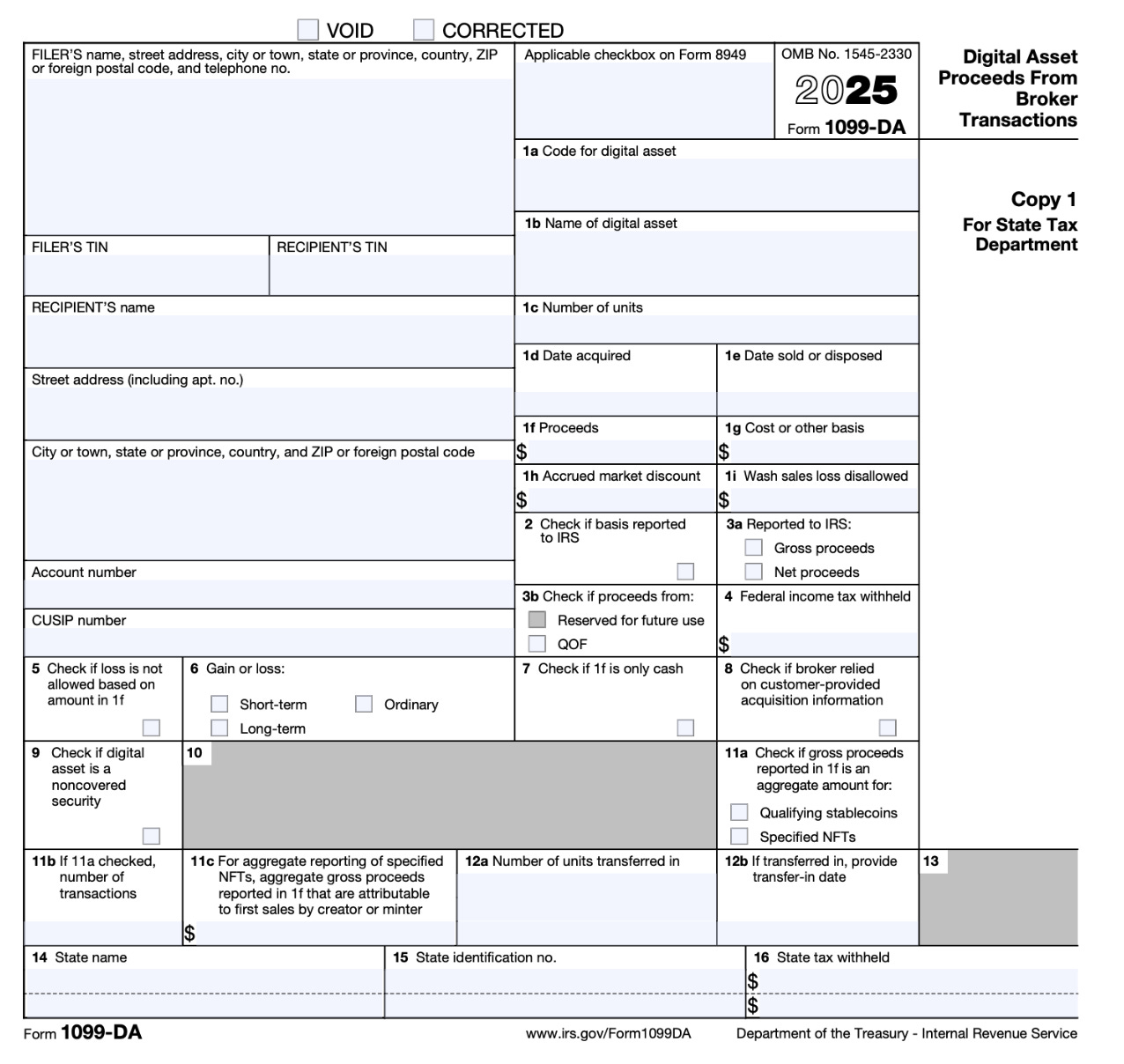
Form 1099-DA is essentially a form for brokers (such as Coinbase or Kraken) to file that summarizes the digital asset trading activity you’ve made on their platform. Think of it like the crypto version of Form 1099-B, which reports proceeds made from stocks, bonds, and other securities. Form 1099-DA reports:
Gross proceeds: The total value received in USD from every time you’ve sold or traded crypto
Information on the digital asset: Token ID, asset name, and the number of units for each asset
Transaction details: Transaction type (whether it was bought, sold, or traded) and the date it was acquired and sold or disposed of.
But what if I’ve conducted thousands of transactions on Coinbase, will they send me stacks and stacks of 1099-DAs? It’s unlikely. Chances are they’re going to issue a single consolidated 1099 statement per account. This may include a 1099-DA for your crypto sales and trades, and separate forms like 1099-MISC for staking income or 1099-INT for interest (if applicable).
Keep in mind, at the moment you’ll likely only receive 1099-DAs from centralized exchanges. So if most of your activity is on Uniswap, don’t spend your days refreshing your email, waiting for your 1099-DA to arrive. It won’t (not anytime soon, anyway).
You got a 1099-DA. What do you do?
If you’ve received a 1099-DA, you’re either unfazed or confused. Maybe you’re used to getting a 1099-B from Robinhood, or any other stock broker, and it’s no big deal. But if you’re in Camp B, and wondering what the heck you’re meant to do with this thing, this part’s for you.
First things first: Don’t panic. You haven’t done anything wrong. This is just a record of your trading activity on one platform.
Next, review your summary. On your 1099-DA, you’re going to see a lot of info. The most important stuff to look out for is a description of the asset that you sold, along with the date and time that you got rid of it, and your proceeds (how much you got for selling it).
Don’t worry if you see a lot of empty fields. Not everything is going to be filled out since for the 2025 tax year, brokers only have to report your proceeds. Which is why your cost basis may be missing (depending on the individual broker and how they choose to report). This is going to change for the 2026 tax year, as all exchanges will be required to report both your proceeds and cost basis, but only for “covered assets.”
What’s a covered asset?
That’s fancy lingo for any asset you buy from a centralized exchange after January 1st, 2026. So, if you went wild and decided to jump into buying crypto as your 2026 new years resolution, you bet you’re going to receive a 1099-DA for all those new assets you bought, along with proceeds and cost basis.
Now what?
If you think getting a 1099-DA from an exchange means all your crypto tax work is done and dusted, think again.
A 1099-DA only reports your activity for the exchange that’s sent it. If you filed your taxes based on just one 1099-DA you got, your number would not only be incomplete, they’d also likely be wrong.
Since exchanges don’t communicate with each other or see general on-chain activity, you still have to do the digging and round up every single different transaction from the various exchanges you use. You can pull this data right from the platforms you use, either by:
Getting the records manually
If you don’t have many transactions, you can export CSV files from all the exchanges you’ve used. Depending on the individual broker, you can often find CSV files in the Tax tab (this is where it sits within Coinbase). You then select the trading period and click generate and download report.
Using a crypto tax platform to import your data automatically
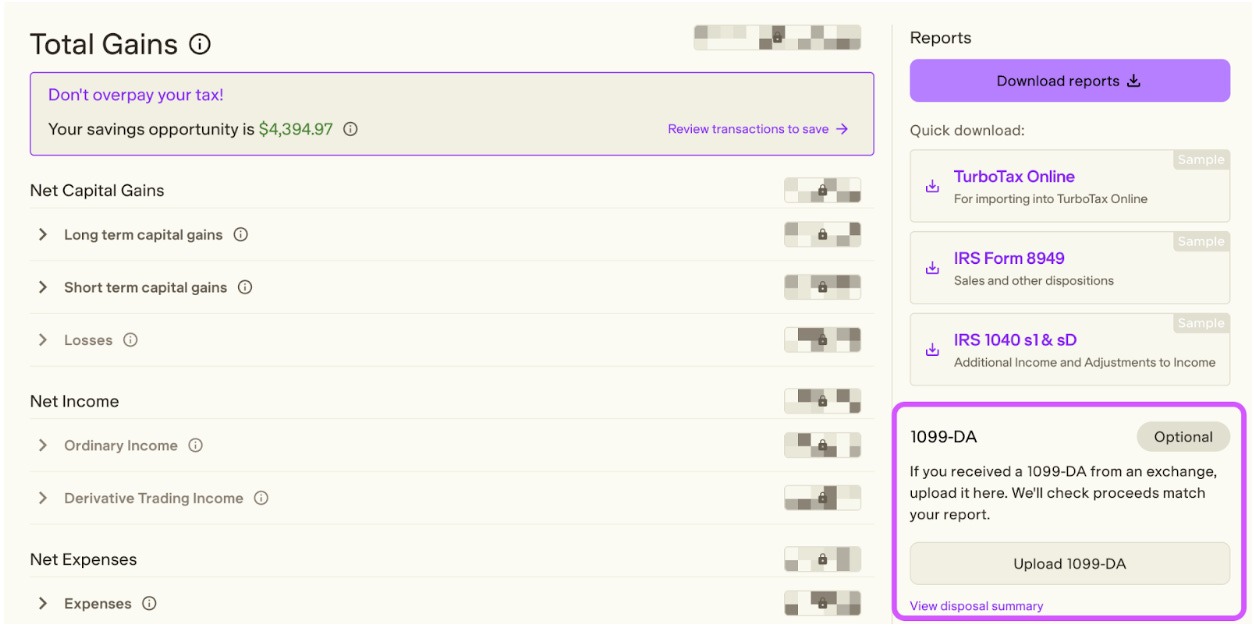
Use a crypto platform like Summ to connect with all your wallets and exchanges and import your complete transaction history.
Users can also verify the accuracy of their tax reports by importing their 1099-DA directly into Summ.
Okay, I have all my transactions. What’s next?
Once you’ve recorded all your transactions, you’ll be able to track your cost basis from any assets you’ve transferred. Using your cost basis for each of your transactions, you’ll be able to figure out your gains and losses.
Finally, you report your gains and losses from each crypto transaction on Form 8949. This works together with Schedule D to provide an overall summary of all your capital gains and losses (including crypto).
EXAMPLE: In 2025, Sam made one transaction on Kraken. He sold one ETH worth $3,200. At the end of January 2026, Sam received a 1099-DA from Kraken reporting the one ETH he sold in 2025. The cost basis was blank, and the proceeds were reported as $3,200.
Since Sam only pays taxes on his capital gains or losses, he’ll need to pull up the numbers on how much he bought and sold the ETH for to figure out his gain/loss. Here’s the formula he’ll use for capital gains/losses:
Proceeds (How much he sold the asset for) – Cost Basis (how much he bought the asset for)
Sam only had one transaction in 2025, so he only needs to report his capital gain or loss for the ETH. However, if he had multiple transactions, he’d need to report his capital gain or loss for each of the transactions he made on Form 8949, then fill in his overall capital gain or loss on Schedule D (including all other non-crypto trades and investments).
The cost basis strategy
*Remember* determining your cost basis isn’t just a matter of bookkeeping, it’s a tax strategy. Whether you are figuring out your cost basis manually or using a crypto tax platform, the accounting method you choose to use can impact your final tax bill:
FIFO (First In First Out): You sell your oldest assets first. This can reduce your cost basis in a bull market, meaning higher gains and overall tax owed. Keep in mind FIFO doesn’t avoid short-term capital gains.
HIFO (Highest In, First Out): You sell the assets with the highest cost basis first. This can result in the highest amount of losses, lowering your capital gains and potentially reducing your tax bill. Keep in mind HIFO also doesn’t avoid short-term capital gains.
LIFO (Last In, First Out): You sell the assets you acquired most recently first. When prices are rising, this could create the highest cost basis and potentially smaller capital gains from disposals.
Which accounting method should you pick? There’s not one right answer, although many choose FIFO because it’s what the IRS automatically applies when no selection has been made, and may reduce long-term capital gains. Meanwhile, others use HIFO since it can consistently reduce your capital gains. But it really depends on what you’re trying to achieve and the existing market conditions, for e.g., if prices are increasing and are expected to continue.
Why a lot of 1099-DAs are wrong (Yep, really)
Exchanges are only able to report the activity that they see on their platform. They can’t see your full crypto history, and they don’t want that responsibility, either.
Once crypto is sent to another exchange, wallet, or DeFi, the initial broker wipes their hands clean of it. This most likely means you’re not getting an accurate picture of your tax liabilities or your overall gain or loss – you have to figure that part out on your own.
While a 1099-DA will report any disposals that occurred on a broker’s platform (such as sales or trading one crypto for another), you won’t find the following on your 1099-DA:
Cost basis (for 2025 tax year). This is vital for reporting your gains and losses
Staking rewards
DeFi transactions
Wrapped tokens
Airdrop income
Mining income
To properly report your taxable gains and losses to the IRS, you need the whole story, not just bits and pieces. If you don’t track your own cost basis you could end up paying taxes on your full proceeds and overpay by many thousands of dollars. Summ will figure out your overall capital gains and losses *and* cost basis automatically.
Remember, you don’t owe taxes on your gross proceeds. You owe taxes on how much money you actually make (your capital gain or loss).
Risks with 1099-DAs
With the onset of 1099-DAs being sent, here’s what’s at risk:
Inaccurate cost basis
This is one of the biggest issues with the first round of 1099-DAs. An exchange can’t accurately calculate the cost basis without having access to your full transaction history. So if you’ve transferred assets from another wallet or decentralized platform, the broker issuing the 1099-DA won’t actually be able to access what you originally paid.
The result? Most exchanges are either going to be leaving cost basis blank (for 2025 tax year), or assuming the cost basis for incoming crypto is market price, so relying solely on 1099-DAs for tax reporting will make it seem like you owe way more taxes than you actually do.
Mismatching
Mismatching between your own data and what’s reported on a 1099-DA can – and will – happen. Exchanges and crypto software use a range of pricing sources and data to determine what a coin was worth when it was acquired. This means that you’ll see differences in the proceeds reported on your 1099-DA and Form 8949.
You can either match the information the IRS has from Form 1099-DA (which may mean paying slightly more taxes), or rely on your own records and report the exact proceed amount. Just be sure to have receipts in case the IRS comes knocking.
Paying extra taxes
Thanks to misinterpreted transactions, inaccurate cost basis, and ignored prior history, you’ll have to be extra vigilant about tracking your crypto transactions yourself, or you’ll pay a whole lot of extra taxes. And no one wants that.
Why Keeping Your Records Matters
In true stalker fashion, the IRS is comparing what you’re reporting on your tax return with the 1099-DAs they’ve been sent. That means any type of discrepancy will be noticed, and you’ll get a fun little message about it to fix things ASAP…or else.
EXAMPLE: Let’s say you sold 1 BTC on Coinbase in May 2025 for $105k.
Coinbase sends a 1099-DA, reporting this to both you and the IRS. If you don’t report this sale, or report it for any amount other than $105k, the IRS will get automatically flagged and you’ll receive a stern warning to fix it. Or plead your case to justify the difference.
Here’s where it gets tricky. This is a clean example, however, not all transactions are. The issue here is that 1099-DAs report proceeds, not profit. So the IRS sees a $105k sale, but they don’t see what price you bought the BTC for, where you bought it from, if you transferred it from another wallet, or how you determined your cost basis. That’s all on you to figure out.
This is where most people get caught out. You’re responsible for:
Cross-checking your 1099’s against your transactions to make sure the numbers add up
Keeping records of all your transactions across wallets and exchanges to determine your cost basis
Making sure you’re reporting your capital gains and losses, not just proceeds
If you don’t keep clear records you not only risk overpaying on taxes, you also won’t have any proof to show the IRS if your numbers don’t match theirs.
Navigating the Shift
The 2025 tax year is just the warm-up for 1099-DAs. Starting in 2026 brokers will be required to report both proceeds and cost basis. But this isn’t going to solve the contextual gaps.
At low volume, you should be able to manage manual tracking and filling in the gaps. But if you’ve got multiple wallets, cross-chain activity, and never-ending transactions, doing your taxes manually may make you want to gouge out your eyes (please don’t).
If you want to avoid the actual pain of doing the manual work, try using a crypto tax platform that aggregates all your wallets and exchanges, can fill in cost basis gaps, and explain mismatches.
Summ taps into all your exchanges and wallets so reporting actually reflects the full picture. Not only does it help reduce the risk of making the IRS mad, it can help save you all the extra dollars you may have spent overpaying taxes if you tried to figure things out manually.
All you need to do is sync your wallets and exchanges with Summ and the platform will reconcile all your transactions to ensure nothing is missing. That means producing reports that can reduce the chance of mismatching, avoid overpaying tax or inventing cost basis, and if mismatches do come up, explain why the differences occurred.
Then you can send the reports to your preferred tax filing platform or your accountant and your job’s done.
Sort out your crypto taxes with Summ. Get 25% off your first year using code BTB25.
Disclaimer: None of this is to be deemed legal or financial advice of any kind. These are *opinions* written by an anonymous group of Ex-Wall Street Tech Bankers and software engineers who moved into affiliate marketing and e-commerce.
Old Books: Are available by clicking here for paid subs. Don’t support scammers selling our old stuff