

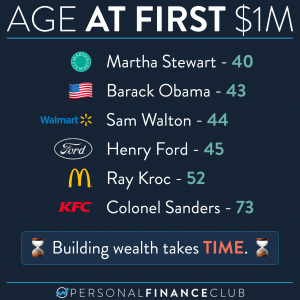
Welcome Avatar! Has been a fun week trolling the NPCs. While we’re all about the exception to the rule crowd (getting rich late in life is possible - Ray Kroc, Harland Sanders etc.), the concept of opening doors is the best way to explain how life works.
If you don’t know what to do, you always choose the option that opens the most doors.
This is because doors close (rapidly) every 5-10 years or so. Going and partying at the dive bar is fine in your early 20s… but by the time you hit 30 you’re entirely out of place. People think this applies to social stuff only. Nope. Applies to work as well.
If you get laid off at age 25 does anyone really bat an eye? No. If you get laid off at 45 after working and becoming niche? You’ve got a real problem.
Not only did your options decline (specialized) but you need to prove that you still have the energy to grind it out (or learn something new). Look no further than Technology for a sector that constantly weeds people out as they age.
“I can always start later, life is long” go ahead and toss this advice out the window. While it is true that you’ll unlikely make money doing what you start out of college, the opportunity to try stuff begins to close. Immediately.
There is a good 10-15 years or so (age 15-30) where you’re allowed to try whatever you like and people will at least entertain the idea of you doing it. We’re drawing the line at ~15 years because you need to go through puberty and get a good sense for what your natural cognitive and physical gifts/burdens are.
The guy who is extremely popular is unlikely going to become an engineer (better off in sales), while the national math champ isn’t going to be knocking on doors (again general rule of thumb)
Why 20s Are So Valuable
Everybody knows that you have more energy. You can run 5 miles, lift, go drink until 2am, wake up at 8am and be at your desk W-2 career like nothing happened. Trying to do that at 40 is simply off the table.
What people miss is that they need to be learning and trying a number of things at the same time. If you go all in on the first thing you’re decent at, chances are high that you miss the biggest talent you’ve got.
Ignore “what I like to do” and go with “what am I unusually good at” from there you create a list and figure out “what industry pays the most for this skillset”.
If you skip any part of the process your chances of becoming successful (no not just money) drops off a massive cliff the size of Mt Everest.
We’re going to write that again. We’ve stated a million times that health > wealth despite the main focus being on making money (our core writing).
If you don’t figure out what you’re good at, you lose more than money. You will lose health and friendships as well. You will incur a lot more stress later in life. The friends that make it will slowly move into different social circles. This is simply how life works.
Since people love step by steps it really boils down to this:
20s: most critical decade to figure out exactly what you are good at before you reach 30. You better be sure as it compounds from here
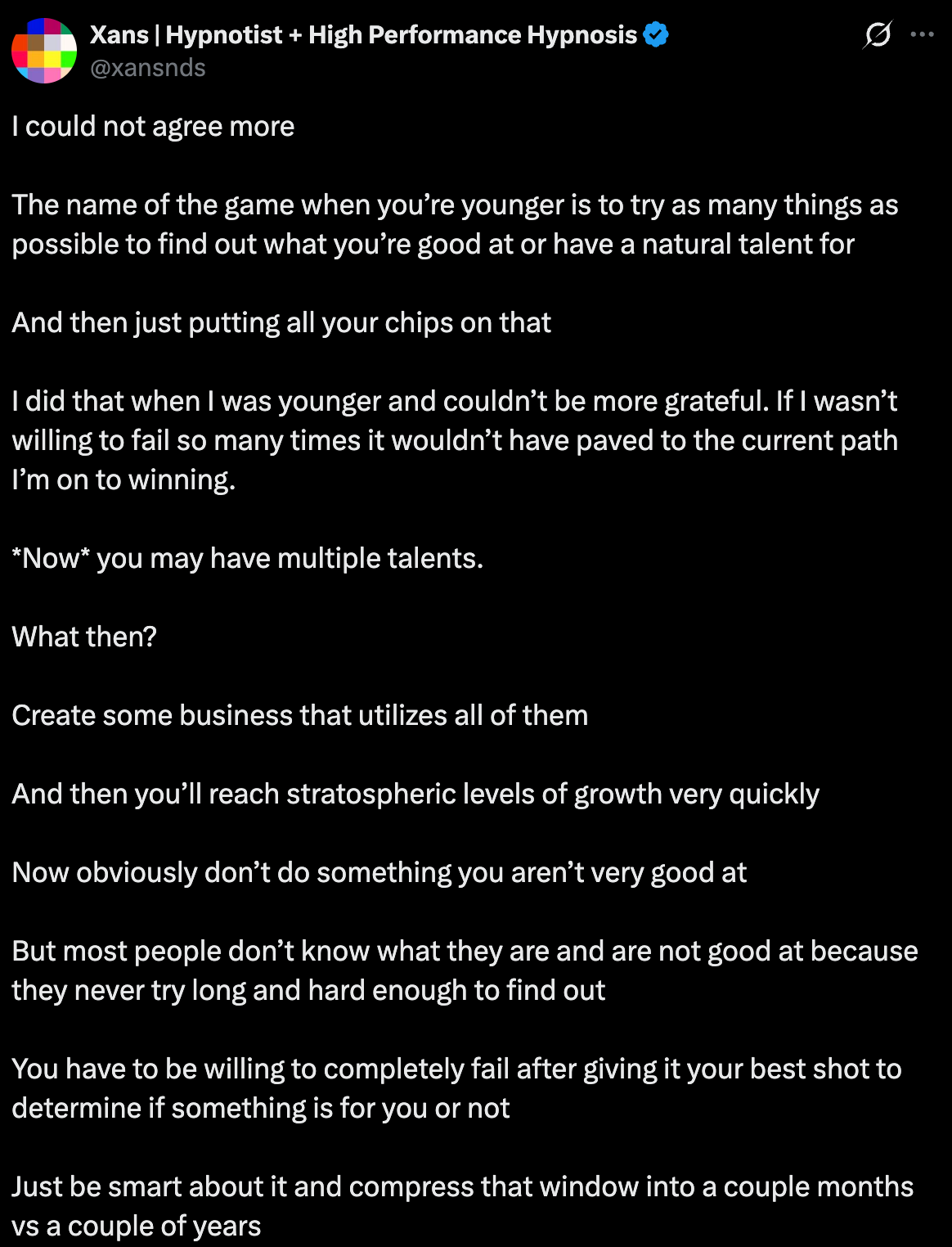
30s: you figure out how to monetize those skills and you take all your social capital to figure out if you plan on having a family or not
40s: you should have figured out the best way to monetize, leaving you with enough time to either 1) be a present parent or 2) scale up a ton of the ideas you got from bullet two
50s: capital moves the needle when compared to effort. You’ve accumulated too many assets for effort to make a sizable difference. You have some hobby income but the real value is how your assets are balanced
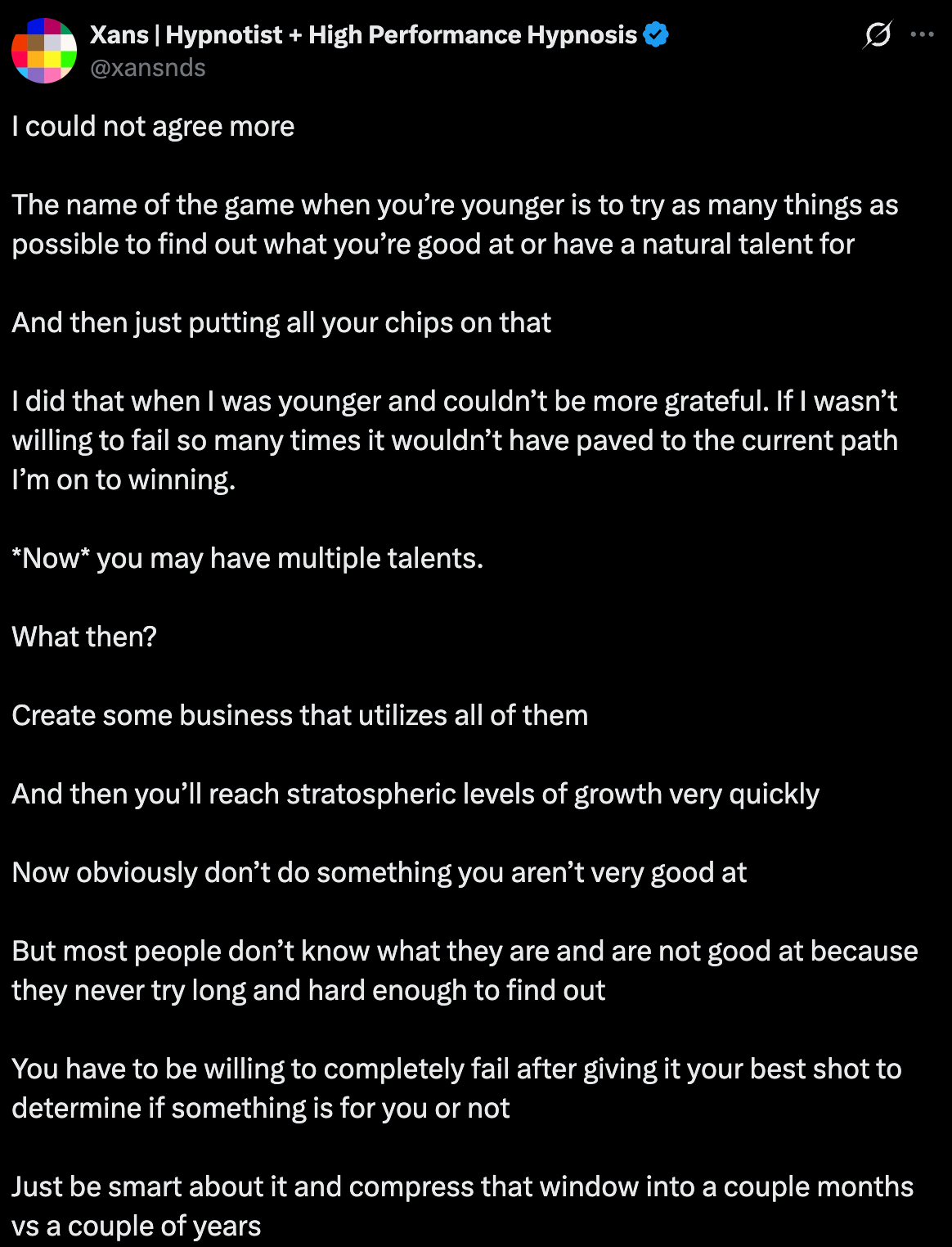
If that’s too long, we’ve got a simple one word framework for each decade: 1) 20s = accumulation, 2) 30s = concentration, 3) 40s = freedom and 4) 50s = judgement.
Accumulate everything, concentrate it to create freedom and spend the rest of your days in a position of judgement.
You can speed up the timeline with talent, effort and self awareness. Unsurprisingly, the last one is the most difficult as it requires a separation of emotion + objective performance.
Corporate Designed for the Worst Outcome
If the above wasn’t enough to convince you, wait until you logic your way through the corporate world. What you’ll find is that the entire structure is designed for the following: 1) plug people in who are good enough, 2) pay them slightly less than they are worth, 3) hit a performance ceiling, 4) drag them out a decade and 5) layoff and replace.
“If I was running a Company I’d only Hire the top 0.00001%!”
Not how it works.
Top talent? Majority try to start a company quickly and are not even in the organization by 30. Let alone 40-50.
If you still find the right people? 100+ other companies likely saw the same thing. No guarantee they choose the firm or stay for a long time.
The end result? Companies typically go for the “safe bet” over and over again. In a cruel way, much like the meme of women settling for the “safe guy”, the company you work for is incentivized to find the “safe employees”.
Put Yourself in Hiring Manager Shoes: You are 30 something. Probably got a mortgage. Or a mortgage + a baby! Either way you are stressed out of your mind with the new responsibilities.
You can choose two people: 1) seems to be the safest bet and 95% chance he is good enough with 2.5% chance he sucks and 2.5% chance he is a rock star or 2) you meet a really unique and extremely quirky high IQ person. Hard to say but you know he’s either 50% the best hire in history or 50% just too strange to fit into the mold. Who do you pick? Yep, you are going with person #1.
You are not risking your career and reputation on someone you barely know. No point in creating attention if you can remain in good standing, collect the “above expectations” review and move on with your life.
This is Why Less Options Exist Up the Ladder: Companies do not hire people in the hopes that they will climb the ranks up to the C-suite. Read that again. They do not care about any hire climbing the ranks to the C-suite. They want to find “good enough” people, make the profit margin and let statistics do the rest.
If you hire 100 people and you expect 95% of them to be in the mediocre bucket, you will get your 2.5% rockstars and 2.5% instant layoffs anyway.
End Result
For the vast majority, this means your current corporate/W-2 career is something you are “above average at” but not elite. Think about that. The entire system is designed to find people who are good enough for about 20 years. If you’re “good enough” to last 20 years, what does that say about your actual unusual niche? It says that your actual main talents would last 30, 40 or even 50 years. Pay more. And. Be easier for you to do on a day to day basis.
Even if you could do more, there is a huge corporate politics lottery game that you need to win as well. In the end, you don’t get to decide if you get a shot or not.
Time to Run Some Math
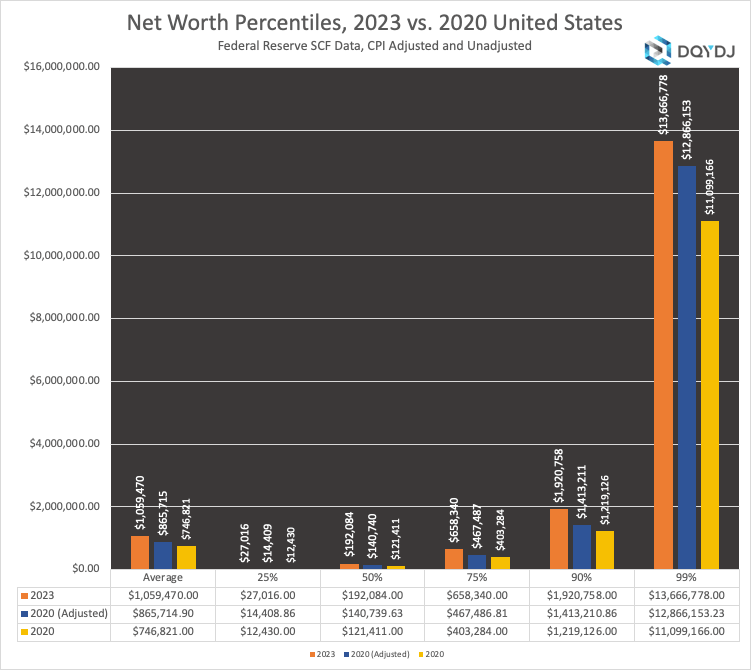
Put this all into perspective by tying it all to your earnings potential. If we’re now in agreement that you’re “above average” but not amazing at what you do, that would land you into the top 10% or so. Think that’s a fair assessment
This would lead you to a long-term average of being worth around $2M.
If instead you decided to find your actual talents and become elite at what your body and mind were designed to do? You’re looking at ~$14M.
Another Cruel Part of Life: If you are talented at something, you need to do a lot less to perform well. If it takes you 40 hours to generate a million dollars of value for the firm, by doing what you’re actually talented at, you could probably generate $5M in half the time (or less). That’s how steep the knee in the curve is from the top 10% to the top 1%.
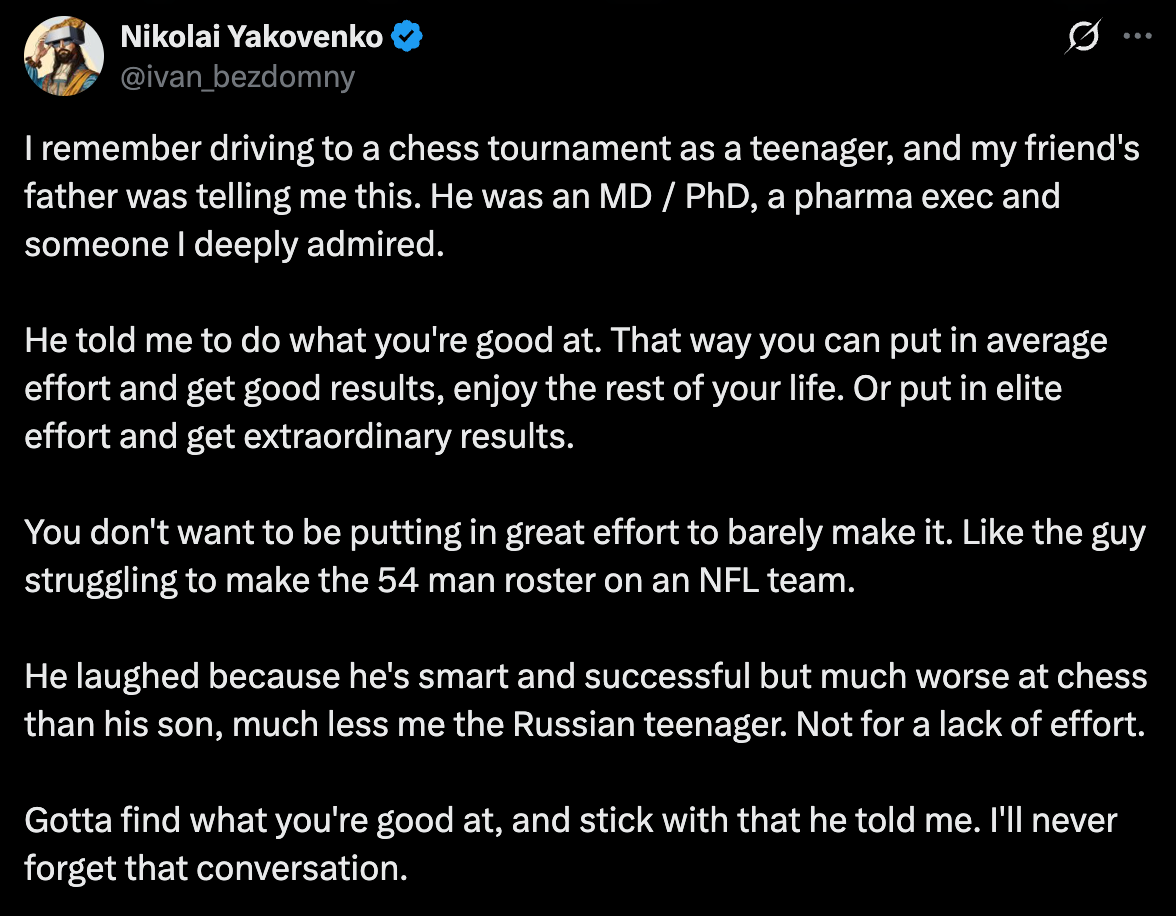
If you want a mathematical way to look at it:
Revenues Scale with 80/20: This means the top 20% generate 80% of the revenue. However. The top 4% (0.2^2) generates 64% (0.8^2) of the revenue. It doesn’t stop there. The top 0.8% (0.2^3) generates 51.2% of the revenue.
Take a wild guess on how much the top 0.8% at FAANG make vs. the top 4%
Square Root the Headcount: This is another rule of thumb. If you square root the entire head count (say 10,000 people) the resulting number is who generates the majority of the value (100 people).
Ask yourself, if you’d still be in your organization if they took the square root of the headcount
Still Don’t Know Where to Start
Depending on where you are in self assessment, you might feel overwhelmed. Most people who read us are beyond that and simply on the paid side going through various new markets and testing demand.
If you’re new then you should do a bottoms up approach. Look at the foundational skills/tools needed in 2026 and beyond.
Sales: If you don’t have any knack for what your skillset is? Start learning sales. This can be in person sales or it could be copywriting. Really doesn’t matter. You will need to have this skill in every aspect of life. Want more dating options? You’re selling yourself. Found your niche skills but need to impress the interviewer? See selling yourself. Found you’re terrible with people but can find trending e-com ideas in seconds? Yep you’ll need to make high quality ads/copywriting skills.
The message is that you choose this as a base layer because it will be useful to you regardless of the path.
Data Literacy: In the end, people are going to choose what they want to buy/sell. This means you’re going to take all those new fancy AI tools and figure out the intention behind the data. You should avoid the trap of saying “oh women like this new lipstick brand”. Instead, you will have to go through all the data related to the new brand.
You need to solve for: 1) what exact age band/ethnicity/location etc. 2) what exact price point, 3) what search filter is causing it and 4) if it is repeatable and if there another similar hole in the market
Similar to sales, data literacy is going to be extremely valuable. Most will take a bunch of information from AI and then make the AI solve for what is important. This is simply not good enough. AI is only at average intelligence. While it can organize the data quite well, the judgement layer leaves much to be desired (to say the least)
How fast can you spot a new market trend? Pick a few, write them down, come back in 6 months… were you right? This doesn’t even cost money if you’re extremely risk averse.
Creating a New Workflow: If you go through the second process this will naturally happen. You’'ll find trends or patterns that are obvious to you but not obvious to 99.9% of people. This needs to be automated with AI/software into something only you look at. In an ideal world, the workflow helps you research any topic you like in half the time.
What Do Strangers Say: Not your mom. Not your best friend. Total strangers. If complete strangers are saying you’re good at something, that’s a hint. Start writing them down and take it seriously.
People are extremely critical. They can’t solve their own lives but they can certainly tell you what to do after your meaningless 1 hour interaction. If strangers are telling you that you’re good at something, this is a sign of being in the top 10% at minimum (already).
Do What You’re Good At
Hopefully you’re convinced at this point. Doing what you love is a terrible starting point. When you’re set for life, you will have decades to spend your time doing what you love.
There is a ton of positivity to glean from this:
It means your current role/job/income stream is not your full potential. Not even close.
It also means that you’re working a lot harder than you should for the same pay. If you found your main talent, you’d work less and make the same or more.
If you accept this as being reality, you will become more objective as it relates to your gifts/abilities
Really nothing negative about it. If you fall for the trap of doing what feels good, don’t be surprised when the door closes and there is no other option to choose from.
Disclaimer: None of this is to be deemed legal or financial advice of any kind. These are *opinions* written by an anonymous group of Ex-Wall Street Tech Bankers and software engineers who moved into affiliate marketing and e-commerce.
Old Books: Are available by clicking here for paid subs. Don’t support scammers selling our old stuff
How ETH is Staked: Covered (here)
Crypto: The DeFi Team built a full course on crypto that will get you up to speed (Click Here)
Crypto Taxes: We have a suggested Tax Partner and 25% discount code, for information see this post.
Security: Our official views on how to store Crypto correctly (Click Here)
Social Media: Check out our Instagram in case we get banned for lifestyle type stuff. Twitter will be for money