

The entire content below is written by Bowtiedbills.
My Exit & Why I’m Writing This
First off, big thank you to BowTiedBull over the years. This Substack was extremely helpful in so many areas. Still can’t believe it’s only $10/mo - easily the best ROI subscription I’ve ever had.
I’m extremely thankful I kept my head down and worked on my own biz for the past few years and got to a point where I now work for myself full-time.
You can read my previous post on how I went from a FAANG Software Engineer to making Wifi Money: Source
The following will be a guide / crash course in profitably generating leads with ads. It contains a breadth of info that I learned by burning my own ad money and making years of mistakes. If something like this existed it would’ve massively helped me out when I was starting. I’m hoping it’ll help you.
Win and Help Win.
Why Lead Generation is Important
It should go without saying, but lead generation is the lifeblood for any service or e-commerce business. When you have an overflow of leads, you enter a positive feedback loop. You have the leverage to turn away nightmare clients, charge premium rates, and be selective with who you work with and what you work on, all of which compound to get you even more leads.
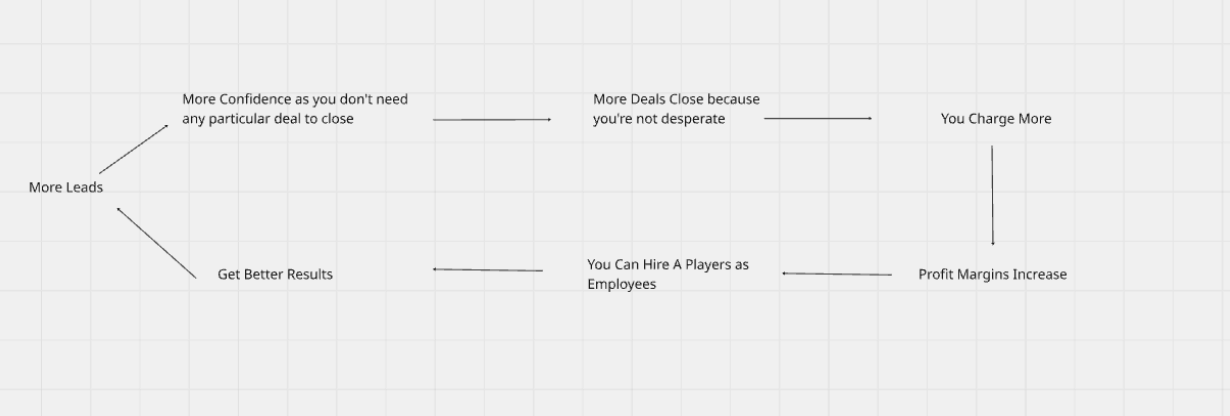
The opposite is also true: a lack of leads forces you to accept sub-par clients just to keep the lights on. This drains your time, lowers your morale, and prevents you from working on high-leverage activities.
Why Most Businesses Struggle With Lead Generation
Most businesses don’t fail at lead generation due to lack of initial effort. They fail because they lack systematic thinking and because they give up too early.
They either jump between different advertising / marketing channels (Google Ads, Meta Ads, SEO, etc) without giving any single one enough time to produce meaningful data, or they stick with a channel but draw the wrong conclusions from the data they get back.
Then they say: “Advertising doesn’t work for me”. That’s pure cope.
Which of the following statements is more likely to be true:
1) Facebook ($1.6T Market Cap) and Google ($3.9T Market) have broken, low performing ad systems OR 2) You suck at advertising
If you think the answer’s 1, just stop reading here, you’re NGMI. Your failure is a skill issue
Internalize this. It is all your responsibility.
The faster you take ownership, the faster you’ll grow
Pre Advertising Fundamentals
Before you spend a single dollar on ads, your marketing process must be sound. At a high level your paid ads process typically follows the flow below. Note: I’m purposely ignoring any nurturing / follow up flows as this is just a high level overview
For Service Businesses:
Identify ICP → Craft Offer → Target Via Ads → Book Meetings → Close
For Ecom:
Identify ICP → Craft Angle → Target Via Ads → Sale
The process is straightforward but most people still screw it up
Step 1: Nail Your ICP (Or You’re Cooked)
I define the Ideal Customer Profile (ICP) as the group of characteristics that make up at least 75% of your client/customer base. Said characteristics include things like age, income, occupation, hobbies, likes, dislikes, fears, desires, etc.
Most people do not spend nearly enough time on this step, which is why their campaigns are doomed from the start. Instead they love to rush into the ads manager and get some ads going.
It’s almost impossible to create a profitable funnel without having a deep understanding of your average customer and the specific problems they are facing.
Why Does ICP Matter So Much?
The reason this step is critical is that it completely changes the messaging you must have in your ads in order for them to succeed.
You need to make sure your messaging is consistent and precise as it pertains to the pain points that your ICP contends with. Most people end up totally whiffing on this within their ads / content / outreach and that’s why it doesn’t work.
They end up using low level messaging to try and attract high level clients.
For example, a lower level ecom owner would talk about profit margin, ROAS (return on ad spend), revenue but the big brand owners are using terms like “contribution margin”, “incrementally” and “GMV” instead.
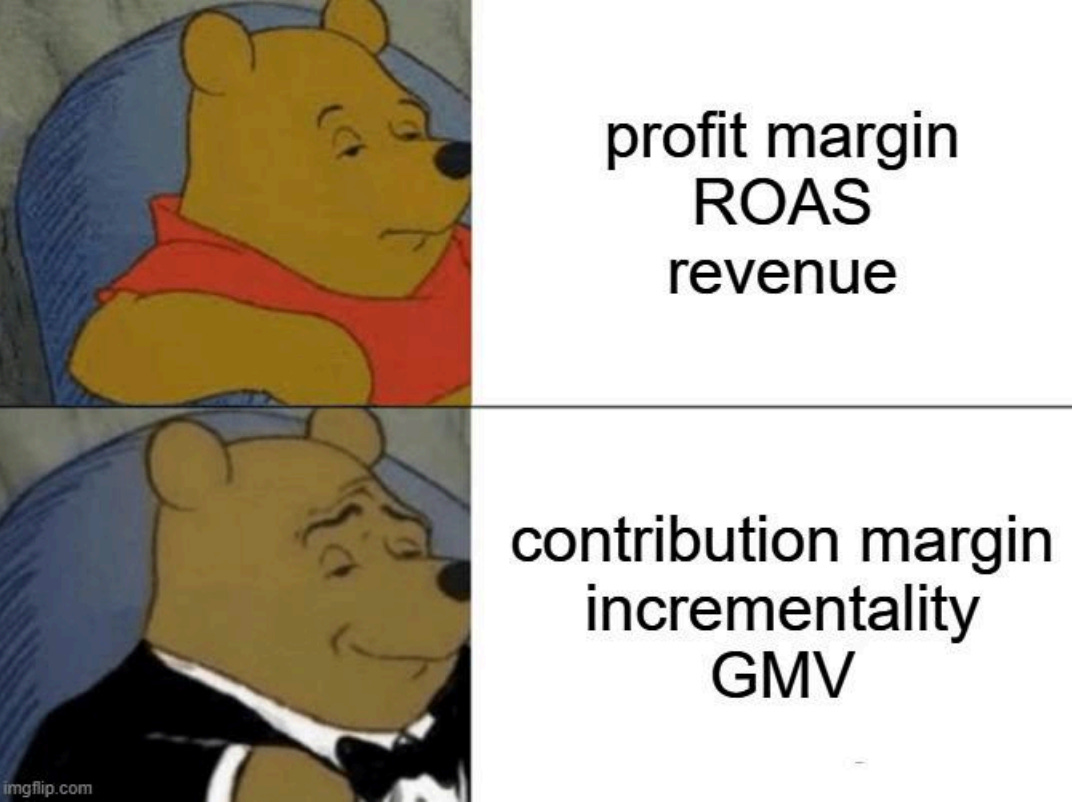
Hopefully this meme will drive the point home. You need to match your messaging with terminology that is specific to their niche and level.
The problems faced by a brand doing $10k/mo are a LOT different than the problems faced by a brand doing $1M/mo.
Similarly, if you’re a wealth manager who is looking for clients with more money, using phrases like “beating the market” will attract people with less assets. Instead you should be referencing things like “tax loss harvesting” or “alternative allocations” to attract wealthier individuals.
You need to get inside the mind of the kind of people you want to draw into your funnel as leads. What words do they use? What problems are important for them to solve? Study them and learn their terminology.
If you don’t know exactly who you’re targeting, you will end up using the wrong messaging in your ads. This messaging won’t resonate with your ideal prospects, which means they won’t convert
Step 2: Avoid Pixel Pollution
Another big mistake that I see quite frequently is allowing anyone to come in and be marked as a conversion. With Meta instant forms in particular, anyone can tap a pop-up, answer a few questions, and get counted as a conversion. There is no qualification whatsoever.
When you do that, you train Meta/Google to optimize for form fills, not revenue. The algorithms learn that any random submit equals success, so they bring you more of those. That’s why you wind up with tire-kickers instead of real prospects.
You need to be doing some kind of qualification on your purely cold traffic, send them to a landing page where you can qualify / disqualify.
This again ties back to the concept of really nailing your ICP, if you don’t have that down, how can you expect to qualify / disqualify people?
Garbage In → Garbage Out
You also need to connect conversions to revenue with offline conversion tracking. Feed closed / won outcomes in a structured format back to your ad platform. This will then train the AI to find more people that are similar to the ones who paid you money in the past, as opposed to anyone with a pulse who can fill out a form.
Step 3: Attain Funnel Clarity
Another big mistake I see, all the time, is lack of detailed analytics tracking. Analytics must be set up to track key user actions even before a conversion happens.
I call these micro-conversions, the small but critical steps that occur between someone landing on your page and ultimately turning into revenue. Things like form starts, scroll depth, button clicks, and funnel step progression are micro-conversions.
I use PostHog on all my landing pages because it gives me session replays (video recordings of visitors on the page) and granular event tracking. I want to see everything: How far did each user scroll? Where did their mouse hover? Which buttons did they click? What sections did they actually stop and read? At which step in the funnel did they drop off?
Without this data, you’re basically flying blind. Everything between “visitor” and “customer” becomes a black box, which makes meaningful optimization almost impossible.
If you’re not comfortable with the more technical setup required with PostHog, Microsoft Clarity works great too and both options are completely free to start.
The bottom line is that you need visibility into what users are doing and not doing on your site before they convert. That’s the only way to identify friction points, troubleshoot effectively, and make your post-click optimization efforts actually move the needle.
Post Click Optimization
Getting the click is step one. Congrats, you’ve got their attention. Now you need to get them to take action.
A common mistake I see in this step is sending people to misaligned landing pages relative to the original search terms / angles used to get the visitors to click.
Imagine someone is sitting in their car at a red light and suddenly they get rear ended. Their neck hurts, their bumper has fallen off their car and they don’t know what to do next.
Naturally, they hit Google and search “personal injury lawyer {city}.” They see your ad, click it, and... land on a generic homepage. The first thing they see is a section on “Slip and Falls”, then “Dog Bites.” Buried at the bottom is a blurb about car accidents.
They are going to click back and bounce to the next guy immediately. And rightfully so.
Now, imagine they landed on a page dedicated to motor vehicle accidents. A page that highlighted your extensive experience with rear-end collisions, showed off cheques from similar settlements, and had a clear CTA to call XXX-XXX-XXXX. The chance of that person converting increases massively.
The same applies to Ecom: if you’re using a specific pain point as a hook in your ads, it should be highlighted in your landing page as well. You need consistency in your messaging from hook/ad to landing page to thank you/post-sell flows.
You also need a single conversion goal. Do not clutter the page with multiple buttons asking them to fill out a form OR call a number. Pick one and stick with it to avoid confusion.
When dealing with the general public, write your copy at a fifth grade level and assume everyone is redacted (they probably are).
“CLICK HERE TO TALK TO A LAWYER FOR FREE” is much better than “Click Here To Schedule A No Obligation Consultation”. You’d be surprised how many people don’t even know what those words mean.
Building Trust
The biggest factor (in my opinion) that stops someone from converting from purely cold traffic is a lack of trust.
Referrals convert like crazy because trust is already baked in. Someone they know has already vouched for you, so most of their resistance disappears. You’re already pre-qualified.
You want cold traffic to feel the same way, so it’s your job to make them feel that way. If you can do this your chances of them converting are much higher. Add specific callouts to convey trust and help people get over their fear immediately in the hero section of your landing page, so everything they’re looking for is available without even having to scroll.
Lead With Tangible Results
You need to hit people with real results immediately and make it obvious that you’re the right choice. Leading with “20 years of experience” is pointless, no one who’s actually good at what they do leads with that.
You want people to know you have the results that prove you can solve their problem right now
Show them something concrete:
Ecom: “10,000+ women with {problem} helped in 202X.”
Lawyers: “500+ criminal cases defended with 95% of clients avoiding jail time.”
These callouts do more for trust and conversions than any fluffy paragraph about your mission, passion, or years of experience do.
Optimizing Your CTA & Forms
Another thing you absolutely need to tighten up is your CTA. Keep it simple. Nobody is filling out a giant form with 20 fields. They’ll bounce the second they see it. Your landing page’s job is to get the conversion with as little friction as possible
Don’t start by asking for their name, phone number, email, etc
Start with something specific to their situation instead. Use a quick quiz so the first step isn’t a dead-end yes/no question.
Example: “On a scale of 1–10, how severe is X right now?”
Better yet, give them something upfront. A free calculator for estimating child support, an injury settlement estimator, a “what’s my case worth?” tool, etc (whatever fits your niche). For those of you who are familiar with poker, you want them “pot committed”
They input their details to get their result, and you grab their contact info right before you show them what they came for.
Make the whole flow 3-4 quick questions max, it should be just enough to filter out the wrong people and make the right people feel like they’re in the right place.
If your conversion goal is for them to call you, make sure all buttons are set up so when clicked they immediately dial.
Similarly if your conversion goal is a booked meeting, don’t send them to a separate scheduling page. Embed the form directly onto your page. One less click = one less point where they can drop off.
Post Conversion Flows
When someone books a call, don’t just hit them with a lazy “thanks, we’ll be in touch.”
Instead use that moment to set the tone, establish authority, and frame the entire experience before they ever speak to you.
Redirect them to a thank-you page that:
answers the most common FAQs
walks them through what’s going to happen on the call
sets expectations for timeline, next steps, and what they should prepare
This instantly positions you as the professional in the room. It reduces no-shows and more importantly builds familiarity which will make the actual call way smoother
Speed to Lead Matters
Look to contact leads via text (can be automated) ideally within 5-7 minutes of them filling out your funnel. Something as simple as:
“Hey {name}, I saw you booked a call for {date}. Is there anything I can help with before then?”
It shows you’re responsive, professional, and actually paying attention, which instantly separates you from most of your competitors who aren’t going the extra mile.
Google Ads Campaign Setup & Budget
For most service businesses, Google Search Ads are my go-to. There’s intent behind the search, which makes conversions way easier. Of course for Ecom, Meta reigns supreme.
One question I get constantly is: “What’s a good starting budget?”.
The truth is: a flat number is meaningless without context. A “reasonable” cost per click (CPC) can range from $3–$5 all the way to $300+, depending entirely on your niche + location combo.
I typically do my keyword research using a simple google sheet and go over the unit economics using conservative assumptions to make sure the funnel will be profitable on paper first. My goal is to get at least 100 clicks to the campaign in a month (ideally 250+) so I can make informed decisions. You can spend more and get the data back faster, or spend less and wait. But you need enough data that the numbers you’re looking at are statistically significant.
The Strategy: 2-Phase Execution
I typically start with a Max Clicks campaign targeting 2-3 keywords. The goal isn’t to scale, it’s to get data back from Google and make sure the marketing fundamentals are solid. This phase is where you plug funnel leaks, fix any bad assumptions you may have and confirm that the landing page + offer actually converts.
Specifically, I’m looking to answer the following questions:
Is the CTR what I projected?
Are my actual CPCs close to the estimates?
Are people converting at the rate I expected?
Where exactly is the drop-off happening in the funnel?
If these boxes check out, I know the landing page works and the offer is good and I’ll continue to increase the spend while making sure it remains profitable.
Important Note: When setting up your campaign, turn OFF all the suggested “AI enhancements” and auto-applies from Google. Do not turn on Display Network / Search Partners.
Scaling Phase: Switching to PMax
Once I’ve gotten 250–300 conversions, I switch the campaign to Performance Max. The key to getting PMax running properly is feeding it high-quality structured conversion data, ideally every day. You must send conversion data back to Google (via API or scheduled Google Sheets uploads) that tells the algorithm:
Which leads generated revenue
Which leads were junk
The algo will then optimize for people who have similar characteristics to those who have successfully converted in your funnel.
If PMax Doesn’t Work
There are some cases where PMax underperforms (relative to Max Clicks). If that happens, I typically just go back to my original Max Clicks campaigns.
Optional: Local Service Ads (If You Have A Google Business Profile)
If you’re a local business, LSAs can be another solid channel. They’re simpler to set up, but you must review every lead because Google often marks garbage as “valid.” Make sure you turn off “Direct Business Search” so you’re not charged for those people who were specifically searching for you anyways
Underrated Angles / Things To Look Out For
Daily Negative Keyword Pruning: On brand new campaigns you need to be looking at your search terms report and adding irrelevant terms to your negative keyword list at the campaign level. This is how you build a strong “master negative keywords” list. If you run lead gen across the same niche in different geo’s, this list becomes a reusable asset that saves you time and money.
Bidding on Competitor Branded Keywords: If you’re new in a niche or city and no one is searching your name yet, experiment by bidding on the competitors branded terms who already get volume. They’re usually cheaper than bidding on the broad service terms directly as most companies don’t typically bid on their own branded keywords. Just be smart about it, avoid using trademarked terms in your ad copy so you don’t trigger legal issues. Executed properly, this is a great way to siphon demand from bigger players
Multi-Language Advertising: If you speak multiple languages, you’re likely leaving easy money on the table by not running campaigns in other languages. Target the same high-intent keywords but in your language, CPCs are usually cheaper, and close rates tend to be higher because people trust someone who shares their background or speaks their native language.
Using Downsells
This won’t apply to every niche, but when it does fit, it’s one of the easiest ways to monetize people in your funnel who want your help but can’t afford your main service.
With a Done-For-You (DFY) service, your income is capped by the following overlap:
People who want/need your service
People who can afford your service
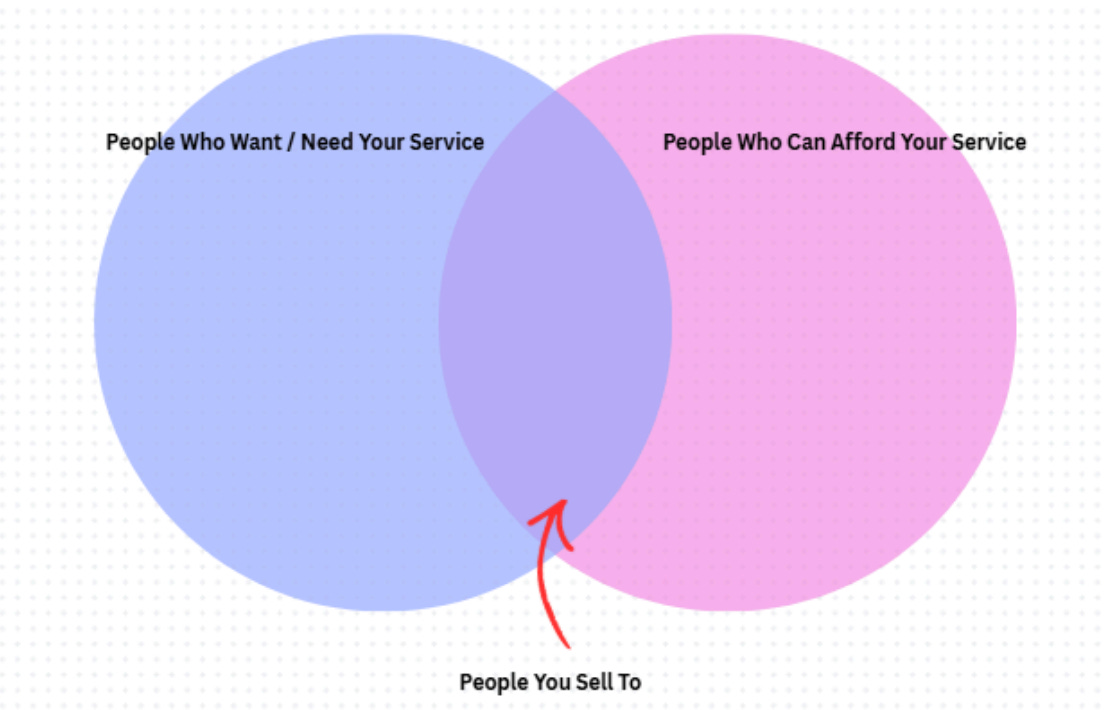
Not everyone who wants your help can afford your DFY pricing, but they likely can afford a down-sell.
You can package your expertise into a lower-ticket info product, an ebook, guide, template bundle, starter program, (whatever makes sense in your niche) and then use that as your down-sell.
This becomes your DIY option for people who aren’t ready (or able) to pay for the full DFY service.
Example: If you’re a personal trainer offering $300–$500/mo coaching, you can create a library of the following and sell them individually or as a bundle for a one time fee for those who say your price is too high.
workout templates
diet plans
beginner programs
habit trackers
A percentage of those people will actually make use of the templates, get results, gain trust in your process, and eventually come back for the full coaching program when they’re ready.
Pricing Strategy
Price the down-sell so it at least covers your cost to acquire the lead. Even if only a small percentage of people take it, that revenue lowers your effective CAC, lets you outspend competitors, and widens the top of your funnel. Instead of only monetizing the tiny group of people who fit your premium bracket, you now make money from a much broader slice of your audience.
Because your CAC is partially or fully offset, you can afford to bid higher and acquire more traffic than anyone else in the niche. Over time, this creates a compounding advantage, the more efficiently you monetize, the more aggressively you can scale, and the wider the gap becomes between you and your competition.
Scaling Considerations
Ensure your operations are able to handle increased load. When scaling your business people tend to think of only making more money, not realizing they’re actually scaling their problems as well.
Accountability
You need to be writing down everything that you’re doing. I know that Bull recommends 3 sentences per day but I take it one step further. I’ve set up a Slack automation that sends me a link to fill out a Google form every hour I set aside to work. The form only has two questions.
What did you do this hour?
What was your focus level & how can it be improved?
The nice thing about Google Forms is that it auto connects to a spreadsheet where everything gets logged so it can easily be reviewed later.
I review this spreadsheet every Sunday and look for recurring tasks that can either be:
Automated
Hired out to take them off my plate
Even if you only get rid of 2 tasks per month, that’s 24 over the course of a year. Stacking these wins adds up over time.
You’ll also find you are not nearly as productive as you think you are. Tough to say you’re “working 10 hours a day” when you have to account for every single hour in writing. This system forces honesty and keeps you accountable in a way that guessing or “feeling” productive never will.
Wrapping Up
Thanks again to BowTiedBull for everything they’ve put out over the years and for letting me write. To the readers: I hope you guys enjoyed this crash course and got something useful out of it.
If you want more leads for your business, DM me on X (bowtiedbills). I’ve got bandwidth for a few more clients / partners starting in January.
Giveaway
I am doing a giveaway 48 hours after this post goes live.
How To Enter:
Follow me on X bowtiedbills
Retweet my latest post (the one that links to this article)
Tag a friend
Must be a free subscriber to BowTiedBull substack - not on the paid section currently. Note: this makes it easier for Bills to simply click the group purchase and figure it is a good holiday gift for people on the fence on the free side for some time
You must do all four to be eligible. 20 winners will be randomly selected after 48 hours.
Each winner receives a full year of BowTiedBull’s Substack – personally paid for by me.
Winners will be publicly announced. Good luck, and see you on Degen Island
BTB Note
Not much to add beyond congrats to BowTiedBills. Had no idea it would be lead generation but everyone has a skillset for something. Find that skill, put it on the internet, digitize and watch as things get better. Knee in the curve still estimated at around 3 years of full throttle effort on one project.
Stay Toon’d
If you have questions related to Bills post we’ll let them stand all other convos will be deleted to keep this clean as he took the time to do everything. Thanks!
Disclaimer: None of this is to be deemed legal or financial advice of any kind. These are *opinions* written by an anonymous group of Ex-Wall Street Tech Bankers and software engineers who moved into affiliate marketing and e-commerce.
Old Books: Are available by clicking here for paid subs. Don’t support scammers selling our old stuff
How ETH is Staked: Covered (here)
Crypto: The DeFi Team built a full course on crypto that will get you up to speed (Click Here)
Crypto Taxes: We have a suggested Tax Partner and 25% discount code, for information see this post. Crypto Tax Calculator (same as always). You can access CTC HERE and get 25% off your first year for being a BTB subscriber. Yes, this also operates as a ref link. (BTB25) the discount is at no cost to you.
Security: Our official views on how to store Crypto correctly (Click Here)
Social Media: Check out our Instagram in case we get banned for lifestyle type stuff. Twitter will be for money
As a fellow ex FAANG Software Engineer that recently escaped Shawshank, congratulations on your successes and great write up. From the WSPB days up until now, BTB has really helped me focus, stay the course, and get to my exit. Still strange being an unemployed bum, I am working on that. haha
Yes easily the best ROI subscription for sure. I gifted a sub to my kid a few years back as he was entering HS. When he talks about his future and his plans I know he has been absorbing this.
The article clearly shows Bills expertise. Not only a great article on lead generation but anyone with sales experience can see that Bills is well versed in sales psychology as well. Thanks 👍 already saved the article to use as a reference